Day 132: Angular Motion Representations, Whiteboarding, & Stoich Problems

AP Physics 1: Angular Motion Representations

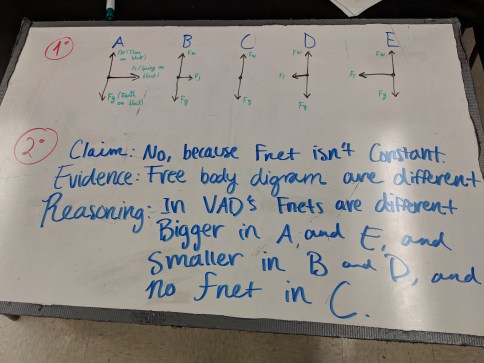
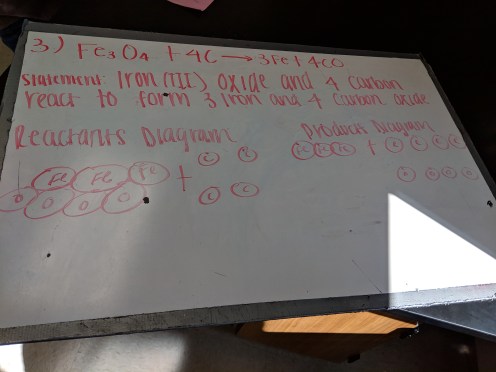
We started by discussing yesterday’s activity to introduce angular velocity; there was some great debate about which dot on the disk was moving the fastest, which lead exactly where I wanted it to. Afterward, students worked on some problems translating between different representations of angular motion. Students fell very easily back into the kind of thinking we’d done with linear motion, which made the problems a breeze.

Physics: Whiteboarding

We finished going over the standing wave problems and took a quiz on the topic.

Chemistry Essentials: Stoichiometry Problems

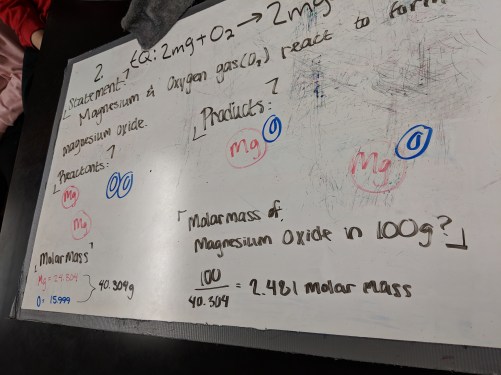
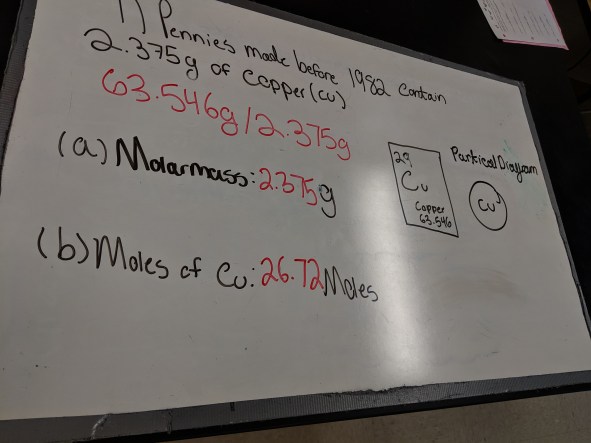
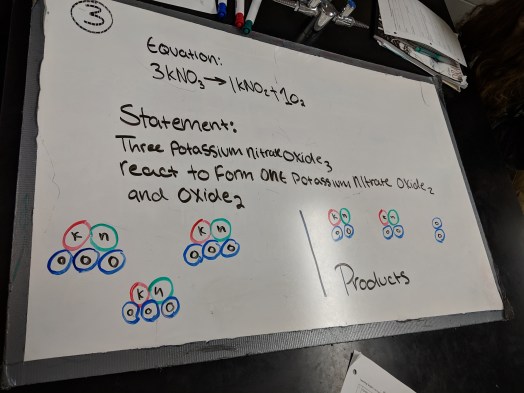
Students worked some stoichiometry problems that included polyatomic ions. Most students are doing very well with the problems, which has me very optimistic about tomorrow’s quiz.

Day 131: Pivot Angular Motion, Whiteboarding, & Pivot Stoich

I am a part of the Pivot Interactive’s Chemistry Fellows program.

AP Physics 1: Pivot Interactives Angular Motion

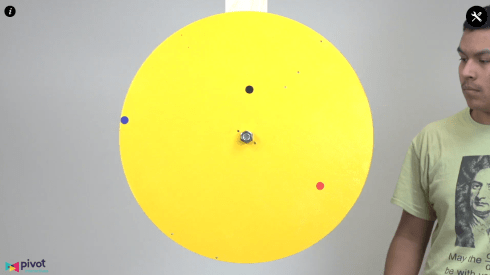
As students finished their torque quiz, I had them use Pivot Interactives to look at the motion of a spinning disk and come up with two different answers to which dot on a spinning disk is moving the fastest. Tomorrow, we’ll use those two answers to get into angular velocity vs. tangential velocity.Pivot angular.PNG
Physics: Whiteboarding

We spent some time whiteboarding yesterday’s problems. Students resisted drawing the diagrams for standing waves, but, once they got the diagrams, they were able to solve the problems.

Chemistry Essentials: Pivot Interactives Stoichiometry

Students used Pivot Interactives to compare their prediction for how much hydrogen gas should be produced in a reaction to how much was actually produced. I ran into an issue where a few students were very insistent that a prediction is a guess, so their calculation could not be a prediction. I didn’t have a great response in the moment aside from in science, a prediction should have something to back it up, which can be a calculation.

Another hurdle I ran into today is I have one section where a lot of students really resist talking to their group members, and the computers made it easier for them to work in isolation. As a result, I realized partway through the hour I was frequently answering the same questions multiple times with a given group and I was helping individual students with portions of the activity their partners knew how to do. I need think about how I can help my students have more productive collaboration within their group.

Pivot stoich.PNG

Day 130: Whiteboarding, Problems, & Lab

AP Physics 1: Whiteboarding

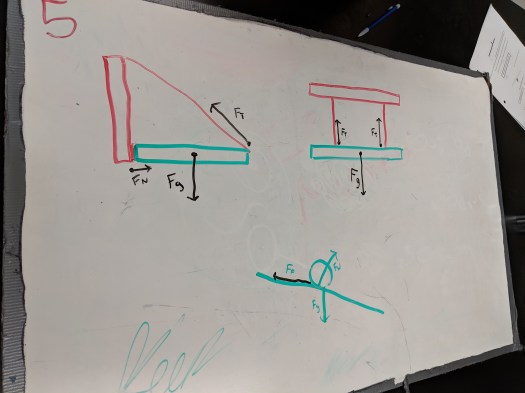
We did some whiteboarding of last week’s torque problems. Students aren’t confident, but they are getting the hang of extended free-body diagrams and successfully solving problems. With the clock ticking, that will have to be good enough for balanced torques.

AP wb.jpg

Physics: Problems

Students did some problems with standing waves. It was tricky for a lot of them to connect the wavelength to the length of the resonator, so that will be something to work on during whiteboarding tomorrow.

Chemistry Essentials: Lab

Students did a lab with magnesium and hydrochloric acid. We stuck with purely qualitative observations today and will get into the actual stoich tomorrow.

chem lab.jpg

Day 126: Levers & Whiteboarding

AP Physics 1: Levers

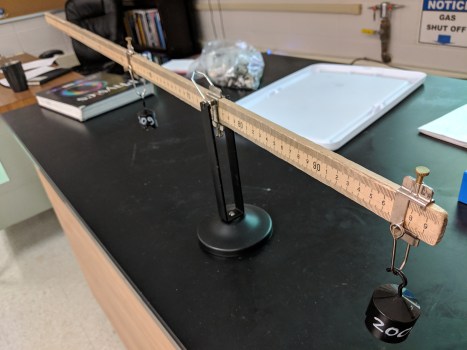
Students did a lab with levers to introduce torque. I usually take 3-4 days on lever labs, so tried to shorten it. In my 2nd hour, I had students graph the ratio of the forces on one axis and the ratio of the radii on the other; the results so far are looking messy, so I think I tried to accomplish too much with that approach. In my other section, I had half the class keep the positions constant and graph the two forces, while the other half of the class keep the forces constant and graphed the distances from the pivot. The results are looking really nice, so I think that was a better abbreviation.

ap lever.jpg

Physics: Whiteboarding

We whiteboarded and discussed a couple of wave problems from TIPERs. Students seemed to find the problems pretty straightforward.

Chemistry Essentials: Gallery Walk

We did a gallery walk to go over Friday’s problems that combined balancing with molar mass. Students are starting to be able to shift away from the blocks we’ve been using for balancing and rely more on their particle diagrams, which is great to see.

chem gallery.jpg

Day 124: Gallery Walk, Board Meeting, & Mistakes Whiteboarding

AP Physics 1: Gallery Walk

Students did a gallery walk of some problems dealing with central net force and universal gravitation. There was a lot of good discussion as students worked on their problem, but I’m not sure how much students looked at the other problems.

Physics: Board Meeting

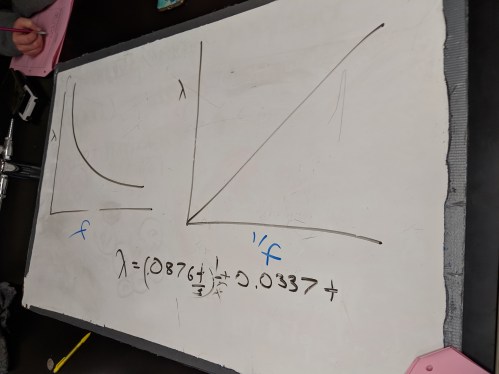
We had a board meeting for the snakey spring lab looking for a relationship between wavelength and frequency.

phys wb

This group used floor tiles as their distance measurement

Chemistry Essentials: Mistakes Whiteboarding

Students worked some problems translating between molar mass and moles of a substance, then did some mistakes whiteboarding to go over the problems.

chem molar mistake.jpg

Day 123: Board Meeting, Snakey Springs, & Molar Mass

Yesterday we had ACT testing for juniors. Seniors had an off-campus learning day.

AP Physics 1: Central Net Force Board Meeting

For yesterday’s off-campus learning day, my students finished collecting data in Pivot Interactives on central net forces. I really enjoyed the discussion of the force vs. mass graphs, when the class realized the units on the slope were the units on acceleration, so we had F=ma.

ap centeal force.jpg

Physics: Snakey Springs

Students used the snakey springs to collect data on a relationship between frequency and wavelength for standing waves.

Chemistry Essentials: Molar Mass

Students used nuts, bolts, and washers to represent different elements in order to discover how to find the molar mass of a compound. Afterward, they tried extending what they’d found to actual compounds. Not only were they very successful at extending their results, their work represented different ways of thinking about polyatomic ions, which was cool.

Day 120: Mistakes Whiteboarding & Lab Practical

AP Physics 1: Circuits Mistakes Whiteboarding

I forgot to take a picture, but students did some mistakes whiteboarding with yesterday’s problems. We moved quickly enough through circuits that I think I’ll need to make sure I have some circuit materials worked into our review, but students are feeling pretty good about this topic.

Physics: Spring Lab Practical

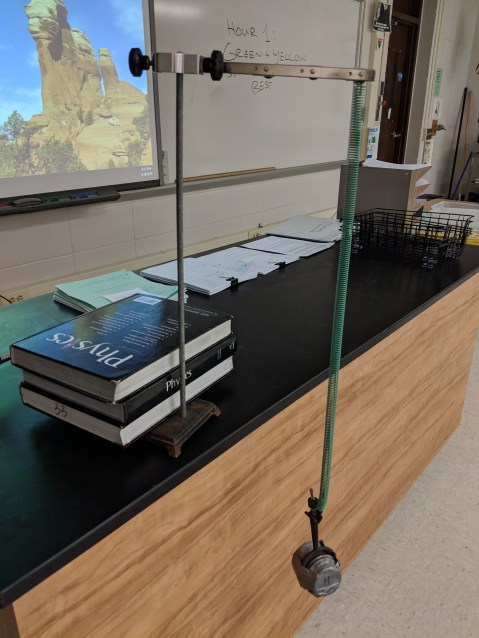
Students finished up a lab practical finding an unknown mass using both Hooke’s Law and the period on a spring. Students who didn’t include units in their work tended to get two different answers; most groups got a spring constant in N/cm and without units in the calculations, they tended to miss the need to convert. It was a good lesson in the value of units. It also occurred to me I should incorporate this lab into my AP review since students are finding both gravitational mass and inertial mass.

spring practical

Chemistry Essentials: Balancing Mistakes

We did mistakes whiteboarding with yesterday’s balancing problems. Right now, students mostly seem to be understanding what to do, but need to build up some confidence. I’m really pleased with how well the Mathlink cubes have been working as a manipulative; they are even helping students quite a bit with going between formulas and particle diagrams.

chem mistake.jpg

Day 118: Board Meeting, Mistakes Whiteboarding, & Conservation of Mass

AP Physics 1: Kirchhoff Board Meeting

We had a board meeting where students shared the rules they’d come up with for current and potential difference, which lead into Kirchhoff’s rules. My students missed some details, especially around current, that I wanted them to see; normally, I would have sent them back to the lab to experiment a little more, but I ended up pointing out the info in the interest of time.

Physics: Mistakes Whiteboarding

We did some mistakes whiteboarding with yesterday’s problems. There are some students who haven’t had me before, so this was their first exposure to mistakes whiteboarding. A few of them started laughing and making some comments when a group clearly had some clearly unintentional mistakes, so I stepped in more than usual and, with help from students who’ve done this before, managed to shift the tone pretty quickly. I’ve been more conscious this year overall that I need to reset the culture in my classroom each trimester, but I dropped the ball today and didn’t revisit what it looks like to contribute during this kind of whiteboard discussion.

phys mistake (1).jpg

Chemistry Essentials: Conservation of Mass Lab

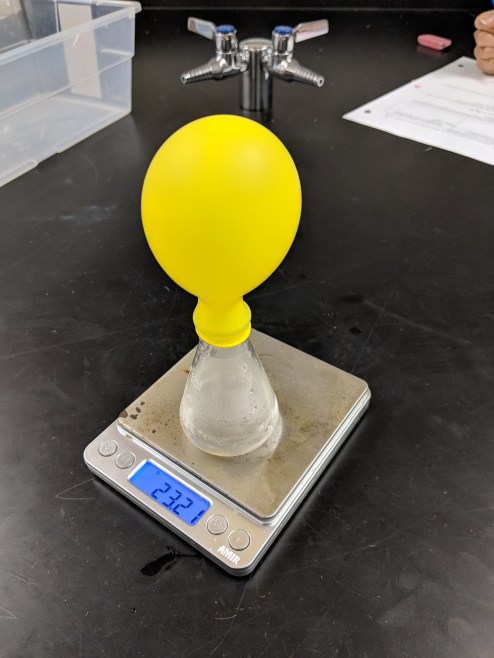
Students did a reaction in a Ziploc bag to see the conservation of mass in action. Students got good results, but balancing the reaction was tricky. The reaction is one of the trickier ones I ask students to balance in this course, so this may have been better near the end of the unit.

reaction in bag.jpg

Day 116: Whiteboarding

AP Physics 1: Coulomb’s Law Whiteboarding

We spent some time doing some practice multiple choice problems, then used whiteboards for a gallery walk of yesterday’s problems on Coulomb’s Law and Ohm’s Law.

Physics: Spring Representations Whiteboarding

Students whiteboarded various representations for an object vibrating on a spring, then we did some discussing to come to an agreement on what those representations should look like.

phys spring (1).jpg

Chemistry Essentials: Mistake Whiteboarding

We finished going through the whiteboards students prepped earlier this week for a round of mistakes whiteboarding. I’m getting excited to start balancing chemical equations with these students next week; several students have started pointing out when the number of a given element changes between the products and reactants as a sign that something is wrong.

Day 114: Ohm’s Law, Spring Period, & Mistakes Whiteboarding

AP Physics 1: Ohm’s Law

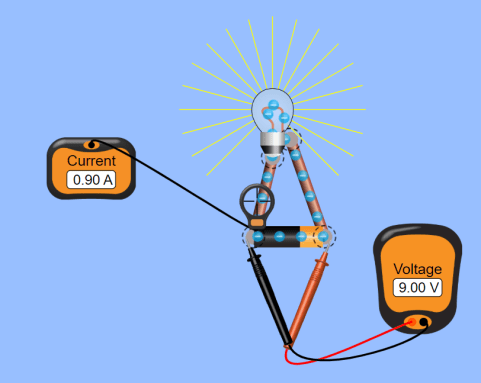
Students used PhET’s circuit construction kit to find a relationship between current, voltage, and resistance. It was the first time students were asked to work with three variables at once on a pretty open-ended lab, but they were very successful at coming up with ways to approach the task.

circuit construction.PNG

Physics: Spring Period

Students finished their data collection and graphing for the period of a spring lab. A lot of groups went straight to a quadratic relationship to linearize their graph, which makes me think they were treating it as an automatic process, rather than thinking through what their graph suggests. It didn’t take much coaching to get students to switch to a square root linearization, but I’ll need to keep working on what it actually means to linearize a graph.

Chemistry Essentials: Mistakes Whiteboarding

We did some mistakes whiteboarding using yesterday’s problems on representing reactions. Students were very successful at figuring out the mistakes and they are gradually getting the hang of the various details they need to carefully represent.

chem mistake.jpg