Physics: Lenses
Students finished the problems from yesterday, then whiteboarded their answers.


Chemistry: Concentration
Students whiteboarded their solutions to the concentration problems from Friday and the solubility lab from yesterday.
Physics: Lenses
Students finished the problems from yesterday, then whiteboarded their answers.
Chemistry: Concentration
Students whiteboarded their solutions to the concentration problems from Friday and the solubility lab from yesterday.
Physics: Lens Misconceptions
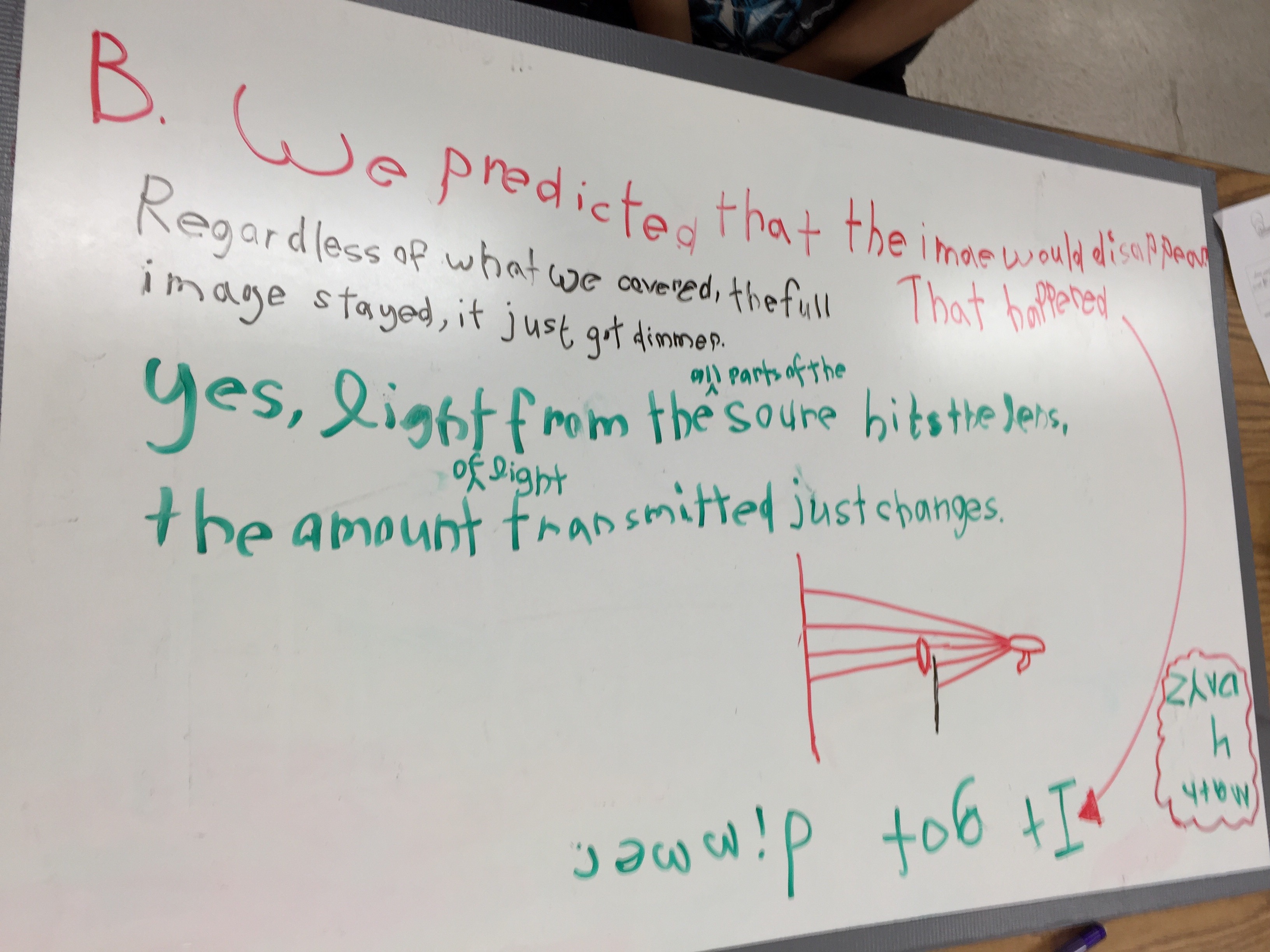
Students whiteboarded and discussed the results of Friday’s lab. I’m always intrigued by the conversations about the image formed when part of the lens is covered up. Students consistently express the common misconception that blocking the lens will block part or all of the image with very little analysis of that idea. Once they saw the full image, however, they quickly and easily made connections to partially covered mirrors to declare a dimmer, but whole image is exactly what they should see. Without the unexpected observations in the lab, my students felt no need to consider related observations or apply tools like ray diagrams to challenge their ideas. I know this is exactly how misconceptions tend to play out (Derek Mueller’s video on Newton’s 3rd law is a great example), but there’s seeing this process happen always fascinates me.
Chemistry: Solubility
Students did a simple solubility lab where they measured how much sugar could be dissolved in water at different temperatures.
Physics: Mistakes Game
We played the mistakes game with ray diagrams for curved mirrors. Its been a while since we last did that, and a lot of students were excited to play.

Chemistry: Speed Dating
We did some whiteboard speed dating with empirical formula problems. By the end of the hour, most students were feeling pretty confident. Just to solidify that confidence, we did a “practice pop quiz” where I put up a problem and had students work through it in quiz-like conditions, then went through the answer and had some conversation about the next steps for people who didn’t do well on that quiz.
Physics: Focal Length
Students started collecting data to produce a plot of image distance vs. object distance for a concave mirror. A lot of students were trying to complete the lab with the mirror, candle, and screen all in a single line, so tomorrow I’ll need to review the directions and give a little more time to collect data.

Chemistry: Whiteboarding
Students whiteboarded yesterday’s problems, then we played the mistakes game. Students seemed pretty confident by the end of the hour, so hopefully tomorrow’s acids and bases quiz will go well.
Physics: Curved Mirrors
We started by whiteboarding yesterday’s reflection problems. Along the way, I had a student stand in front of a nice, long horizontal mirror while someone else held a whiteboard between the student and the mirror to show a blocked object can still form an image. Afterward, students started making some qualitative observations about curved mirrors. My favorite part was when students noticed the hologram mirror I had out and start puzzling through what was going on. Even once the opened it up, students were eager to try changing the setup to see what would happen and test their ideas. I think some students were legitimately excited when I told them we’d draw the ray diagram for it later this week.

Chemistry: Neutralization Reactions
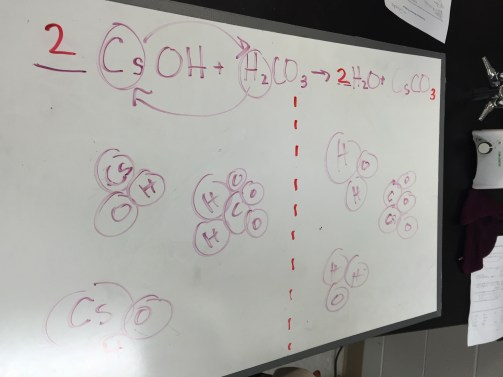
Students practiced determining the products in neutralization reaction. I was pretty pleased when a student asked “Aren’t these just double replacement reactions?” Last tri, a lot of students struggled to connect one day in class to the next, so this tri I’ve been much more intentional about trying to help students make those connections, so it’s gratifying to see students looking for links between new and old topics unprompted.
Physics: Whiteboarding
I had all of my students for the first time this week! We did some abbreviated whiteboarding of the labs and problems from this week as a way to summarize the big ideas we’ve been working on.

Chemistry: Equilibrium
Students set up a reversible reaction in several test tubes, then experimented with how to change the equilibrium. Afterward, we spent some time discussing the role energy plays in why some of the methods to disturb equilibrium worked.

Physics: Pinhole Cameras
Students built simple pinhole cameras, then experimented with how to change the image that appeared and drew some ray diagrams to explain their observations. A lot of students were really thinking deeply about what the ray diagrams mean and how to interpret them to understand the image produced, which was great to see.


Chemistry: Reaction Types
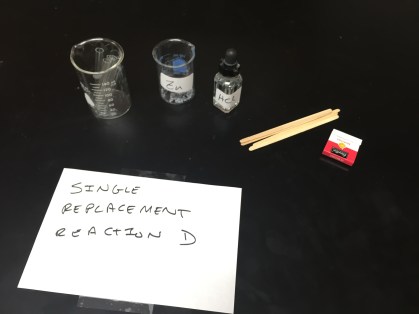
Students did a lab where they observed each of the five reaction types in action. Several groups were really thinking through how their observations connected back to the reaction equation, which lead to some great conversations.
Physics: Ray Diagram Whiteboarding
Students whiteboarded their solutions to the shadow and color worksheets from earlier this week. Students had a good grasp of the ray diagrams and there was some good discussion about the color stuff. We used some overhead projectors with stained glass panes to test a few of the color questions.

Chemistry: Reaction Types Whiteboarding
Students whiteboarded their solutions to the problems on yesterday’s lab. Compared to last tri, students had a much better grasp of the different types, especially single replacement and double replacement. I think the Legos helped reinforced the physical meaning of the reaction equations.
Physics: Color
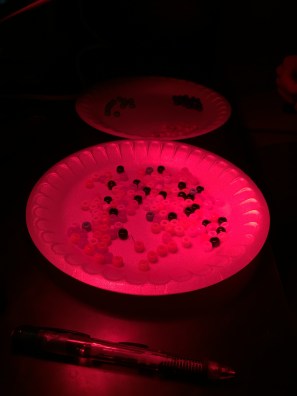
Students put colored beads under different colored light bulbs and tried to pick out the red, green, and blue beads. In addition to coming up with a measure for how easy it was to sort the beads, they kept track of which beads they tended to mistake for which color.
Chemistry: Lab Discussion
We spent some time discussing yesterday’s percent yield lab. Previously, we’ve only done problems where the mole ratio is a whole number, so I was a little worried doing a lab with a fractional ratio, but that worry was misplaced. I need to stay out of the trap of underestimating my students. There was also some good discussion about why the percent yield was not 100%.
Physics: Closed Pipes
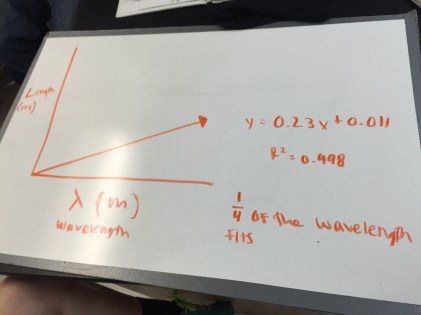
Students whiteboarded and discussed their results from yesterday’s lab on closed pipe resonators. They pretty easily recognized that, since the graphs of tube length vs. wavelength consistently have a slope near 0.25, 1/4 of the wave must have “fit” into the tube to produce a standing wave. This lab is traditionally used to find the speed of sound, but I always ended up just giving them length = wavelength/4, which bugged me. By having students use the lab to find that relationship, they only needed to use relationship between speed, wavelength, and frequency they found using snakey springs and the speed of sound, which they found using both a Direct Measurement Video and a Vernier microphone.
Chemistry: Percent Yield
Students continued working on their percent yield problems today. We spent some time discussing the physical meaning of the numbers they were using, especially the numbers in the balanced chemical equation and the molar masses since confusion about what those represent lead to a lot of the struggles students had on yesterday’s quiz.
Simultaneously Learning & Teaching
Ideas for Physics Teachers
explorations and inspirations... in how we learn science
Brian reflects on his physics teaching
(sometimes) daily updates about physics classes, mistakes, and sensemaking
Recording reflections about teaching and learning
Physics, Modeling Instruction, Educational Technology, and other stuff I find interesting
Reflections on the dynamics of teaching
Ever tried. Ever failed. No matter. Try again. Fail again. Fail better. - Samuel Beckett
Physics questions, ideas, hare-brained schemes
 stoeckel180