Day 133: Board Meeting, Pendulum Practical, & Percent Yield

AP Physics: Board Meeting

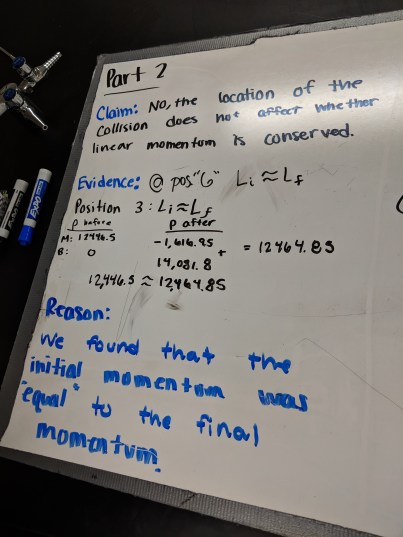
Students whiteboarded their results from yesterday’s Pivot Interactives activity. Students spent a lot of their time yesterday on whether the location of the collision affects whether linear momentum was conserved, but had a lot of interesting approaches and good discussion about that question. For the portions of the activity specific to angular momentum, I ended up much more teacher-directed than I like since I will be out tomorrow and am feeling the time crunch of the looming AP exam.
Maker:S,Date:2017-10-21,Ver:6,Lens:Kan03,Act:Lar02,E-Y

Physics: Pendulum Practical

Students finished yesterday’s practical, then were tasked with finding the period of a pendulum without using a ruler or meterstick. Not surprisingly, most students declared the pendulum practical was much easier than the spring one.

Maker:S,Date:2017-10-21,Ver:6,Lens:Kan03,Act:Lar02,E-Y

Chemistry Essentials: Percent Yield

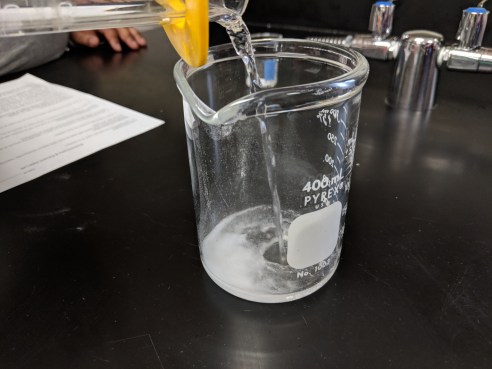
Students predicted how much carbon dioxide should be produced in a reaction between baking soda and hydrochloric acid, then found the percent yield by measuring how much mass was “lost” during their reaction. I like that this lab circles back to conservation of mass to measure the mass of gas produced, but a lot of students had trouble connecting the lab to the stoichiometry problems we’ve done, so I need to think about how the layout and wording of the lab may be making those connections more difficult.
chem yield lab.jpg

Day 132: Angular Momentum, Lab Practical, & Popcorn

We had a snow day yesterday. Students (and teachers!) are getting restless for spring; after seeing the grass and even a few dandelions sprout last week, it was tough to get another 18 inches of snow.

AP Physics: Angular Momentum

Students used Pivot Interactives to explore angular momentum using a collision between a marble and a block. I started by having students determine whether the location of the impact changed whether linear momentum was conserved, which lead to some great conversations. A few students needed some reminders about linear momentum, but that wasn’t surprising given I haven’t done a great job of spiraling back to earlier topics this term.

pivot ang momentum.PNG

Physics: Lab Practical

I gave students some springs we haven’t worked with yet and asked them to make a graph with period on one axis where the slope could be used to find the spring constant. This was the first time I’ve had students go backwards from an equation to picking a graph to make, so it was a little tricky, but students had some great conversations about the relationships they were working with. Next year, I’d like to try to get more lab practicals that focus on graphs rather than just calculations.

spring practical.jpg

Chemistry Essentials: Popcorn

Students determined the percent yield for a bag of popcorn by finding how many kernels remained unpopped. It was messy, but it gave students a nice, concrete foundation for what percent yield means. It also came up in the discussion why some of the popcorn kernels didn’t pop, which could make this lab something to come back to when students want to blame less than 100% yield on doing the lab wrong or (shudder) human error.

popcorn.jpg

Day 121: Free Response, Practical, & Quiz

Today is the last day before spring break.

AP Physics: Free Response

We took some time to look at the free response problems from the tri 2 final exam. A lot of students ran out of time on the final, so we spent some time discussing strategies for time management and steps they can take even when they think they are lost on a problem. We didn’t talk about anything ground-breaking and even the physics seemed pretty clear once we got into it; I think the stress of finals got to students and made it tough to use skills they know.

Physics: Projectile Practical

Students wrapped up the horizontal projectile practical from yesterday. One of the advantages of doing projectiles after energy is I didn’t trip up any groups by switching out the marble for a lighter one. Usually, I get at least some groups that do some wild math to try and figure out what the mass changes, but this year’s students either pointed out the mass never showed up in their calculations or used conservation of energy to show it doesn’t matter.

Maker:S,Date:2017-10-21,Ver:6,Lens:Kan03,Act:Lar02,E-Y

Chemistry Essentials: Quiz

Students took a quiz on balancing and representing chemical reactions. I always have a few students in this course who have trouble staying quiet once they are finished; today, all of the conversations I shut down while students were testing were about problems on the quiz, which was pretty awesome. I felt a little bad telling them it wasn’t the right time for those conversations, especially with how passionate the conversations were.

Day 120: Practicals & Demos

AP Physics: Central Force Practical

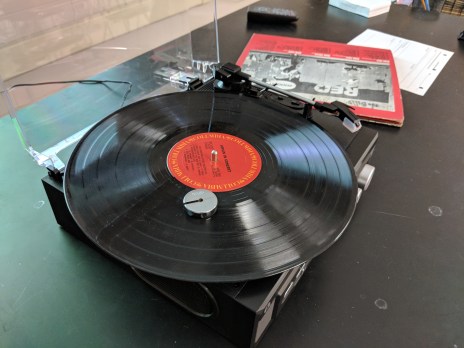
I got out the record player and, as a class, we found where a mass starts to slip when the player is at 33 1/3 rpm. Students then calculated what radius they should place the same mass at when the record player is at 45 rpm. Since the velocity depends on the radius, the math got a little hairy, but students were pretty successful working through it and making sense of how all the variables were connected.

record.jpg

Physics: Projectile Practical

Students rolled a marble down a short ramp to turn it into a horizontal and predicted where it should hit the floor. Both my classes were able to complete it with less support than I expected. After each group managed to hit the target (an old carbon-copy referral form), I asked them to predict where, relative to their first marble, a lighter one should land.

horiz proj.jpg

Chemistry Essentials: Demos

Students balanced a few different chemical reactions, then I demonstrated those reactions. Most of the students seem to be getting pretty confident with both skills and enjoyed the demonstrations. The thing I struggled with is the demos felt very separate from the balancing since they did confirm or otherwise add to the work students had done. I’m wondering if there is something I could have done differently to connect those two pieces better.

Day 110: Final Exams

Today is day 1 of final exams.

AP Physics

Students took  the multiple choice portion of an AP practice exam. I left the rotation and circular motion questions in, even though we haven’t touched those topics yet, since students have a 1 in 4 chance of getting them right and it will give me some information on their existing ideas. I made sure to communicate this to students in advance, including that I will adjust my grading accordingly, which helped students approach those questions calmly.

Physics

About half of the period was spent on an individual exam that was pretty traditional and the other half was a lab practical that students completed in small groups. Due to limits on equipment and space, about half the class was doing each portion at a time, which made for a noisy testing environment than usual. If we take this approach again, I might see if another teacher could accommodate my students working on the individual portion. I also think the individual and lab practical portions of the final represent two very different purposes; I think that is a reflection of my counterpart and I both being stretched a little thin this year and not having many opportunities to talk about why we’re doing things a certain way.

Maker:S,Date:2017-10-21,Ver:6,Lens:Kan03,Act:Lar02,E-Y

Chemistry Essentials

Students took a pretty traditional final exam. No matter how long I make the test, it consistently takes students about an hour to finish; I think a lot of students simply reach a point where they can’t focus anymore, especially since this tends to be their last final (honestly, I usually have trouble concentrating by this point during finals). I decided to plan for an hour-long final and used the first 30 min of the block to whiteboard portions of the final review. I think that helped some students build confidence and it felt like a relief for many of them to have some collaborative time.

Day 103: Mystery Circuits, Explosions, & Formula Relay

AP Physics: Mystery Circuits

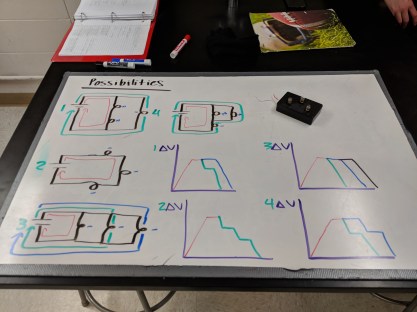
Students did a lab practical from The Physics Teacher to figure out how three light bulbs were wired together without opening the boxes. I did a little extra front-loading by asking students to sketch circuit paths and KVL diagrams, which set them up nicely to figure out what was going on in their box. A lot of students are disappointed that this is effectively the end of our circuit unit; its too bad I can’t direct my students towards the electronics courses in the IT department since they are seniors.

mystery circuit.jpg

Physics: Cart Explosions

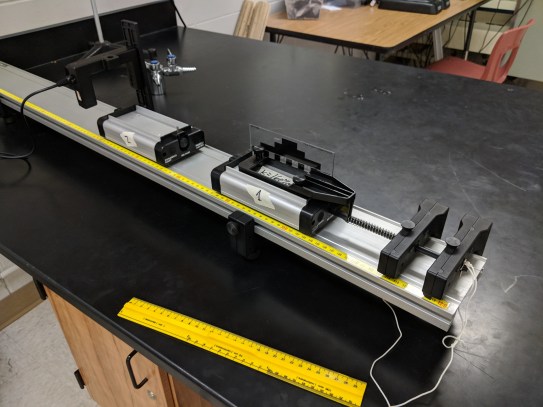
Students started collecting data on a series of cart explosions to introduce conservation of momentum by plotting the ratio of the cart masses vs. the ratio of the distance each traveled in order to hit the end stops simultaneously. I didn’t overhear any groups anticipating where to start their carts, which is unusual for this lab, but some groups were able to make limited predictions with a little prompting.

explosion.jpg

Chemistry Essentials: Formula Relay

Students did some more formula writing practice. Today, I had them work on whiteboards and required them to rotate who did the writing. A lot of my groups have fallen into a pattern where one or two people do most of the intellectual heavy lifting, and it was clearly challenging for them to have to articulate what to do instead taking the marker. There were also some students who have been relatively passive during group activities who seemed like they started to get the hang of formula writing, which is exactly what I hoped.

Day 90: Multiple Choice, Practical, & Bohr Model

AP Physics: Multiple Choice

Students took a quiz, then we used Plickers to practice some multiple choice. I intentionally picked some problems that go back to topics from earlier this year. I also spent some time reviewing what it looks like to take full advantage of this activity, and saw students more engaged than last time. I think doing multiple choice less often was a good call.

img_2398

Physics: Practical

Students wrapped up the energy practical they started yesterday. I added a couple of conceptual questions to the task, and was pleased with the conversations I overheard. I think next time I’ll make explaining your group’s answer to those questions part of testing out the result.

Maker:S,Date:2017-10-21,Ver:6,Lens:Kan03,Act:Lar02,E-ve

Chemistry Essentials: Bohr Model

Students used PhET’s Build an Atom simulation to play with the Bohr model and explore how it connects to the periodic table. A few students wanted to know why we are using the Bohr model when the quantum model from yesterday’s reading is more complete, which is a great opener for conversation about what makes a useful scientific model.

build atom.PNG

Day 89: Superposition, Energy Practical, & Atomic Models

AP Physics: Superposition

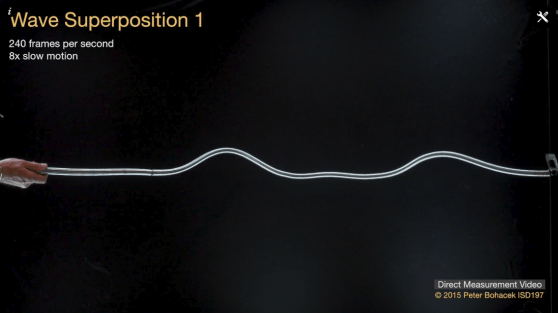
After a little playing with the snakey springs, students went to Pivot Interactives to explore wave superposition. There was a lot of great discussion about whether the wave pulses passed through each other or bounced off each other with students making some pretty detailed observations of the pulses.

pivot superposition.PNG

Physics: Energy Practical

Students worked on using conservation of energy to determine where to place a photogate on a ramp to get a cart moving at a certain velocity. A lot of groups had trouble interpreting their height measurements; I think a lot of them were not keeping track of where they placed the reference height. One group recognized this is pretty similar to the kinetic energy lab we did and used their lab results to confirm today’s calculation.

MVIMG_20180131_131952.jpg

Chemistry Essentials: Atomic Models

I still haven’t found a way I’m really happy with to address the state standard about the evolution of atomic models, but today was the day I tried. I used a POGIL activity where students read some summaries of the major steps in the atomic model and answered some questions. A few students felt overwhelmed by the length of the reading, so we talked about how to use the section headings to make it more manageable. I liked this better than last tri’s jigsaw since doing the full reading seemed to help more of them see the different models as part of the same story.

Day 76: Projectile Practical, Pie Charts, & Whiteboarding

AP Physics: Projectile Practical

Students did a lab practical to predict where a horizontal projectile will hit the ground. Once they succeeded, I asked them to predict where a lighter marble would land without any new measurements aside from mass. Some groups had an easier time than others explaining their prediction, so I need to keep embedding these opportunities in labs and holding students accountable for thorough explanations.

carbon-paper

Retired referral forms work well as carbon paper

Physics: Pie Charts

Students worked on sketching energy pie charts. I added defining the system today; during forces, we almost always ended up with systems that had a single object, so a few students were bothered by including multiple objects. I also worked very hard to avoid telling students whether they were right or wrong, which drove a few of them nuts, but pushed them to justify their answers to their groups.

Chemistry Essentials: Whiteboarding

Groups whiteboarded yesterday’s problems. I decided to have all groups whiteboard the same problem without any intentional mistakes, then have a consensus-building discussion for each problem. Students were pretty engaged; a lot of students who checked out yesterday felt like they had some extra accountability, which in turn pushed them to ask more questions and have some good discussions.

chem wb.jpg

Day 72: Projectiles, Forces Practical, & Qualitative Gas Laws

AP Physics: Projectiles

We worked through some problems I got from Michael Lerner where students apply other models from this year so far to an object dropped straight down and I was pleased with the connections students were making. I also asked students to predict what should happen to the time if the object were heavier and if it were launched horizontally, and got some great discussion. We wrapped up by trying each and checking the results with slow-motion video.


Physics: Forces Practical

Students wrapped up the forces practical from yesterday. I scaffolded the practical more than usual by breaking it into small steps, asking students for each representation and several calculations along the way. Several students commented that was very helpful when they took another look at the problems from earlier this week.

Chemistry Essentials: Qualitative Gas Laws

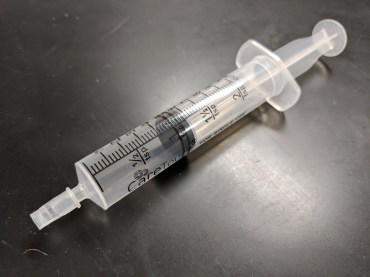
I got out the syringes for students to make some qualitative observations about the ideal gas laws. The ice water baths didn’t produce much change for the groups I was able to talk to today. With this class, I’m spending more time redirecting students or dealing with groups damaging lab equipment than I am talking to students about chemistry, so I need to think about how to shift that. There is a para who is going to work on helping to keep students on task. I also need to remember the instructional coaches have offered to help manage things on lab days.

syringe.jpg

Classroom Display

Earlier this week, I put up a “Scientists can be…” display inspired by Liz Mastalio. Its been a lot of fun listening to students react to it; some are looking for which ones they don’t know while others are clearly drawn to specific identities. My AP students have been telling me who they’d like to see up there, so I want to open the door for them to submit a poster with a label. That could help me get some identities I missed that matter to my students.

Maker:S,Date:2017-10-21,Ver:6,Lens:Kan03,Act:Lar02,E-ve