Day 58: Scoring Guide, Broken Circles, & Steel Wool

AP Physics: Scoring Guide

The tri 1 final exam included some free response problems off past AP tests, so today I gave students the scoring guides and some student samples to make sense of the scoring before letting them see their own tests. One of the problems was problem 3 off the 2016 free response and, inspired by a participant in Greg Jacob’s AP Summer Institute, I used rubber bands to make a bumpy ramp so we could actually try out the experiment in the problem. The class had some good discussion about key takeaways, like the importance of explaining EVERYTHING. Students also noticed that the student samples with high scores had a lot of marking the text.

Physics: Broken Circles

I struggled to get the class culture I wanted in my physics class last trimester and, with students shuffling between hours and about half coming from the other physics teacher, the new tri is a great opportunity to try again. Students worked on a broken circles activity from Designing Groupwork  by Lotan & Cohen, then we had some discussion about what it took to succeed and how that fits with what effective groups in physics look like.

broken circles.jpg

Chemistry Essentials: Steel Wool

This course is two trimesters long, and we only offer the second half during tri 3, so I’m restarting the first half of the course with a new group of students. Students measured the mass of steel wool before and after pulling it apart. To help students focus on good lab practice, I had them do the experiment once with minimal instructions. Then, we had a brief discussion to get at some sources of error before students completed the lab again with a handout and a paper plate to help catch stray bits of steel wool. Just like tri 1, I made a class histogram with Post-Its, but the results were much nicer this time.

chem histo


Day 36: Dueling Buggies, Bowling Balls, & Properties of Mixtures

AP Physics: Dueling Buggies

We did an abbreviated whiteboard session on Thursday’s problems since students had correct answers and were feeling pretty confident on the material. Afterward, we started working on the dueling buggies lab practical. I had several groups decide to have different people try different approaches, then compare answers as a way to check their work. Tomorrow, we’ll actually crash the buggies.

buggies.jpg

Physics: Bowling Balls

I started class today by talking a little about why I use Modeling Instruction and the kinds of actions that make a student successful in this type of classroom. Students seemed receptive and the atmosphere in the room was much more positive than it has been in a while. I think moving on to forces was a good call.

Students worked on the bowling ball and mallets lab to start building ideas about forces. I also gave students roles within their groups and explained this was to help them learn how to be a productive member of the group, even when they don’t know the answers. Students were much more consistently engaged than I’ve seen this year and a lot of great conversations were happening in groups.

bowling

Chemistry Essentials: Properties of Mixtures

As a demo, I asked students to observe properties of water and ethanol before and after mixing. The whole class discussion got a little rocky because a lot of students had great questions and great observations, but it was tough to keep them from talking over each other (or me). That’s something I need to keep working on with this class, but its a good problem to have.

Afterward, students did something very similar with solid sulfur and iron. Again, there were a lot of great observations. Students seem pretty clear on the idea that a mixture has a combination of properties from both materials.

fe s.jpg

Day 18: Group Roles & Relative Humidity

AP Physics: Group Roles

I assigned students to groups for the day, rather than letting them choose their usual groups, to get them talking to some new people. To help with that, I randomly assigned them to roles I borrowed from the University of Minnesota’s Physics Education Research group. We also talked a little about some of the ways race and gender affect group dynamics, and how group roles can be a way to combat that. In their groups, students whiteboarded their solution to yesterday’s Equation Jeopardy problem, which lead to some great discussions about the physical meaning of terms in the equation. Afterwards, I tasked each group with finding at least two different solutions to the XKCD substitute problem. A few students grumbled that finding two solutions meant they had to try something besides their preferred approach, but also realized that was probably the point 🙂


Earth Science: Relative Humidity

Students used hygrometers to measure the relative humidity of the classroom, then spent some time looking for patterns in the chart used for reading a hygrometer to look for patterns. Once they were looking for those patterns, my students were more off-task than usual. I think part of the problem is they were having more trouble than I expected interpreting the chart, but I also think I need to revisit expectations for when students are in the lab.

Day 10: Assessment Day!

Both my classes took their first assessments today.

AP Physics

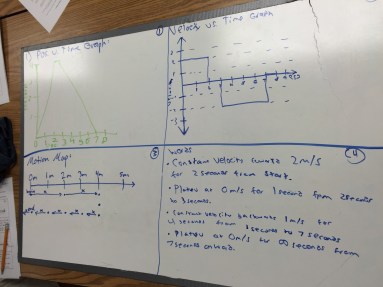
On a problem where students were asked to determine the change in position from a velocity vs. time graph, I had a lot of students describe the motion of the object, instead. We spent more time in class describing motion than calculating, which probably primed students to jump straight to describing. A recurring theme at my AP Summer Institute is that students should read back over the question to make sure they are answering what is being asked, so this will be a good opportunity to discuss that strategy.

Earth Science

After the quiz, we spent some time talking about what makes an effective lab group. I need to keep reminding myself that collaboration is a skill and time spent on those conversations does pay off.

Day 5: Lab Group Contracts & Branches of Earth Science

AP Physics: Lab Group Contracts & Mistakes Game

We started by talking about some of the skills that highly effective lab groups tend to demonstrate. From there, I asked each lab group to write a short contract for themselves they could use to help develop those skills and hold each other accountable. Most of the contracts are fairly broad or vague, I think because I was vague about what I wanted, but groups had some good conversations about their strengths and weaknesses. My favorite item is the group that agreed to “criticize everything.”

After that, students got their first taste of the Mistakes Game. I started by using a recent cooking disaster to discuss the value of examining mistakes, rather than ideal solutions, then introduced the mistakes game. Students readily embraced this approach; I spoke less and heard better questions than much later in the year last year.

img_2177

Earth Science: Branches of Earth Science

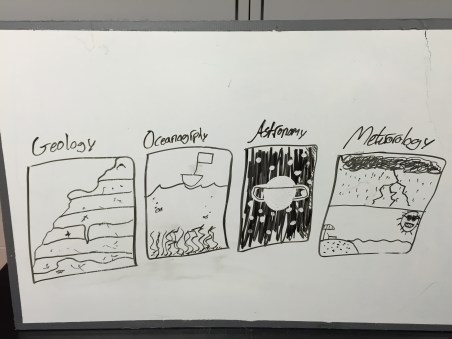
Students attempted to answer the question “what is earth science?” I asked each group to make a visual representation of their answer, including something to indicate the four main branches of the field. Students worried about their artistic abilities at first, but ended up getting into it. I had them use whiteboards, and it was great to see groups really talk to each other instead of each disappearing into their own papers.

img_2176


Day 51: Color Intro & Collaborative Problem Solving

Physical Science: Color Intro

For the first half of the period today, my students presented their research projects on different energy sources. Once that was finished, we started on color. I started by having students watch a short video that I blatantly copied from Frank Noschese that shows red ink and red light through both red and blue filters. I like the video because I can show all my students at once and I like having my own version so students can look at the clock and paper I used in the video to verify I wasn’t using some kind of trickery. I asked students to record their observations from the video, then try to come up with a hypothesis to explain their observations. This lead nicely into a lab where students look at things through filter paddles. Once students finish the lab, we’ll revisit the video to see how their explanation has changed.

Physics: Collaborative Problem Solving

I took a problem from Casey Rutherford’s projectile motion packet about a block given a push up a ramp with friction, then allowed to fly off the end of the ramp to become a projectile. One of the things I love about this problem is it requires to students to use just about everything from the trimester. 2nd hour, students did whiteboard speed dating, but I put a couple of goal-less problems first so students didn’t have much time to work on it, but were intrigued enough by the problem that they asked to continue next week. 4th hour, I decided to start with that problem. I had students work in groups using the roles from the University of Minnesota’s Cooperative Group Problem Solving protocol. It took most of the hour, but students were consistently successful and even my top students were challenged. It was great to see the obvious pride when students finally got the correct answer.

IMG_1421

Day 23: Design Testing & Free Fall Practical

Physical Science: Design Testing

Today, all of my students were early and anxious for class to start. They knew that we’d be loading up their designs with eggs, then sending them down ramps to see how they did. At the end of the hour, we had a brief, but good, discussion about what it could mean to have the “best” design and the limits of the single test we used. This discussion will provide some good groundwork for our second round of designing and building.

https://youtu.be/ubfCIJQJP-A

Physics: Free Fall Practical

Students had two tasks today. For both tasks, I assigned students roles from the University of Minnesota’s cooperative group problem-solving process. First, they did a practical on free fall. Each group was given a time, and had to place tape on a strip of acrylic so that a photogate would measure the time they drew when they dropped their acrylic.

One group's solution to the practical

One group’s solution to the practical

Once groups had tested their result, they worked on XKCD’s Substitute Problem. While most groups decided to chug through the algebra, there was one that used Desmos to find the intersection of the position vs. time graphs.

One group's solution to the sub problem

One group’s solution to the sub problem

Day 2: Groupwork Norms & Buggy Lab

Physical Science: Groupwork Norms

As a follow up to yesterday’s Marshmallow Challenge, we had some discussion about the importance of mistakes and revision in building a tower, then compared that to learning science. Groups also reflected on what they did that helped them work together effectively. Those reflections lead to class-wide norms for group work. One suggestion was “Don’t copy someone else’s epic fails”; it got edited to “Learn from others’ mistakes”, but a piece of me wishes we’d kept the original wording.

Physics: Buggy Lab

Students collected data with the constant speed buggies based on the procedures groups planned yesterday. Just about every group ran into at least one issue that forced them to rethink the details of their approach. That lead to some great conversations within groups about balancing ideal data collection against what’s possible in the lab, including what makes data “good enough.”