Day 120: Kirchoff’s Laws & Rock vs. Minerals

AP Physics: Kirchoff’s Laws & Plickers

I split the class period today into two halves. In the first half, we got out resistors and power supplies to do the real-world version of the Kirchoff’s Laws lab students did on Wednesday. My directions were to see if the patterns they’d found Wednesday worked with today’s materials. I used the same slide as last year, but students had a much harder time figuring out what to do this year. I think the problem is we spent yesterday whiteboarding a different lab, while last year I kept the simulation and real-world versions of Kirchoff’s Rules back-to-back. Next year, I think I will take advantage of my department’s iPads and the HTML5 version of the sim to do it in my classroom. Then I can split up the labs by series and parallel, rather than by simulation and real-world and working around when I can get a computer lab.

The other half of the class, we used Plickers to revisit some multiple choice problems from last tri’s final exam. One problem asked why the speed of a projectile does not change at the highest point. After talking to some other teachers, I really like thinking about that one from an energy perspective, using the idea that a force perpendicular to the motion will not change the energy. To drive that home, I used a mallet to get a bowling ball going in a circle so we could talk about whether the force from the mallet changed the bowling ball’s energy.

plicker

Earth Science: Rocks vs. Minerals

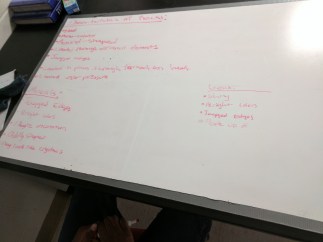
Students used their work from yesterday to identify some of the key differences between rocks and minerals. Since the book of stereograms students used yesterday also had a gem section, I included those in our discussion. Students pretty quickly recognized they had trouble identifying characteristics distinguished minerals and gemstones, which lead nicely into the idea that gems are just particularly valuable minerals.
category

Day 119: Whiteboarding & Mineral Intro

AP Physics: Whiteboarding

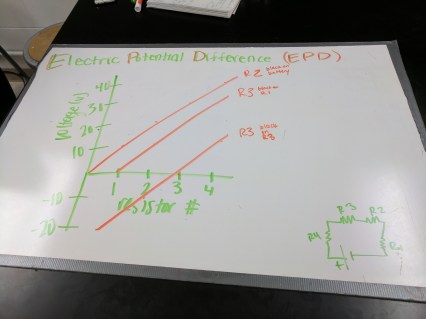
Students whiteboarded their results for the Ohm’s Law lab and an electric potential difference activity I had them try in yesterday’s sim. Students plotted voltage vs. resistor with the multimeter’s ground probe in several different positions to see the change is always the same. The analogy between gravitational potential and electric potential doesn’t seem as clear for my students as in the past, so next year I might go back to having students map electric potential.epd

Earth Science: Mineral Stereograms

I did a few notes on what caused the early Earth to melt and form layers. Afterward, students spent some time with books of stereograms of rocks, minerals, and gemstones. I wrote some questions to get students thinking about the key characteristics of each category and it was fun to listen to some of the things students were noticing.

stereo

Day 118: Circuit Sim Again & Earth’s Layers

AP Physics: Circuit Sim Again

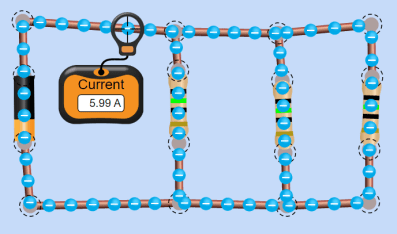
Students used PhET’s circuit construction kit to explore Kirchoff’s Laws in series and parallel circuits. I also tried to mimic an extension of an electric field mapping lab by having students place the ground probe of the voltmeter at different points in the circuit, then move the measuring probe around the circuit. I liked that this got students noticing that the total change in voltage is always the same and it got them thinking about what a negative voltage means. On the Kirchoff’s Laws portion of the activity, I saw a lot more variation in how students thought about the patterns than in the past, which was a lot of fun. I was especially impressed when one student pretty much derived the equivalent resistance for a parallel circuit.

parallel.PNG

Earth Science: Earth’s Layers

Today, we built on the scale diagrams students made yesterday, adding some information on the properties of each layer. I tried to get some deeper thinking by asking questions like how two layers could have similar composition, but different densities, and it was a little tougher than I expected. I think if I’d primed students with some questions about pressure, that task may have been easier. It bothered me to just state give students information about the interior of the Earth, so I spent a few minutes talking about seismic tomography with my students. Next time I teach the course, I’d love to come up with a lesson to give students an analogous experience.

Day 117: Ohm’s Law & Earth’s Layers

I almost forgot about my blog post today!

AP Physics: Ohm’s Law

We got out the power supplies and resistors to see if the formula students found for Ohm’s Law in the sim yesterday also works in the real world. Students were getting good results and I overheard a lot of good talk about uncertainty.

Earth Science: Earth’s Layers

Students worked on a scale drawing of the interior of the earth. I like students comparing the thickness of the layers and getting a sense of scale by adding some features like Mount Everest or an ocean trench. The questions are fairly superficial, so I need to think about what kind of deeper thinking I want them to do tomorrow. I do like the way the Mystery Tubes lead into this, since we don’t have any direct observations of Earth’s interior.

Day 116: Circuit Sim & Mystery Tube

AP Physics: Circuit Sim

Students used the PhET Circiut Construction Kit to start exploring circuits. Students had some great conversations around a few questions about the blue dots I took from the PUM curriculum. I was surprised to hear some students say the blue dots must get used up since batteries die over time, but students were able to test that idea by removing their battery. This lead a few students to connect back to momentum, thinking of the battery as a source of impulse, which I thought was an interesting connection.

circuit

Earth Science: Mystery Tubes

With the start of a new trimester, students got shuffled again. A little over 75% of my 9th graders haven’t had me yet this year, so I will need to make sure I am paying attention to classroom culture and helping students understand what I want from them.

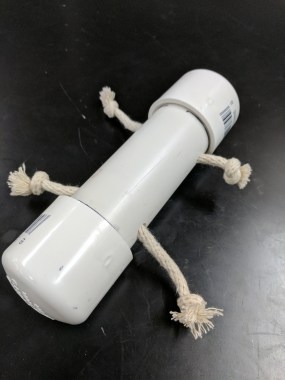
To get students practicing observations and inferences, I had them play with the mystery tubes. In their notebooks, I asked students to explicitly connect each inference to at least one of their observations with an arrow. Several groups were surprised when I told them their sketch of the inside of the tube was a useful inference, so I know I’ll need to do some work with this group explicitly valuing non-verbal representations. Tomorrow, I’ll take some time to connect this activity to the scientific process and how I want to approach this course.

mystery tube.jpg

Day 58: Tri 1 Reflection

Its day 2 of final exams, so I took a few minutes to look back on the year so far.

AP Physics

One of my goals this year has been to continue improving the quality of student discussions and I feel like I’m getting some really good discussions this year, though I find myself talking a lot less in 2nd hour. I think part of it is I’ve got some more vocal personalities in my 2nd hour, so I need to work on helping students in my 4th hour who have great things to say speak up more. Next tri, I’m going to try talking to each group about their results as they prep their whiteboards and point out questions or observations they should bring up or try to build on during the whole-class discussion.

At the start of the year, I thought a lot about group dynamics and wanted to work really teaching students how to collaborate effectively. I did some good things in that area at the start of the year, but let a lot of that fall by the wayside as the year progressed. A new trimester is a good time to bring back some of that explicit focus on group skills.

Earth Science

This was my first time teaching earth science since 2008, so I mostly followed the curriculum of a very experienced earth science teacher. If I teach this course again, I need to plan on changing the sequence quite a bit. The teacher I followed is very good about getting the right kind of activity at the right time (for example, something easy at the start of a term or something active on a Friday), but the conceptual development often felt very disjointed to me. I need to spend some time this summer working on the storylines that I want to use in earth science, then rebuilding the curriculum to fit that.

Day 57: Final Exams

Final exams are today and tomorrow!

AP Physics

I modified one of the College Board’s practice exams to cut out the material we haven’t addressed yet and fit into a 90 min period. I also added a released free-response question from an actual test. My students have been struggling with what a good “explain your reasoning” response looks like, so I think I’ll put together some anonymous responses to those questions, and ask students to score them using the official scoring guide next week.

After school yesterday, it was fun to talk to some students who came in for help. The students who came in were generally eager to share the ways they think about concepts and the connections they are making. One student in particular started out feeling overwhelmed by the course, but is feeling extremely confident going into the final.

finals

Earth Science

I’m not particularly excited about my 9th grade final; its a pretty standard written, comprehensive final. In the future, I’d like to move to a 9th grade final that emphasizes the practices of science and engineering, maybe borrowing some ideas from Kelly O’Shea. I might start working on that for my 9th grade finals later this year. If I can get to something that embeds the science content meaningfully and is easy to grade quickly, I might even be able to get some of the other 9th grade teachers on board. In 10th grade, our students take a state science test where the only 9th grade material that appears is the science and engineering practices, which suggests that’s what we need to be most certain students are getting from our 9th grade sequence.

Day 56: Toilet Paper Drops & Review

AP Physics: Toilet Paper Drops

Students wrapped up yesterday’s lab practical and got  chance to try dropping their toilet paper rolls. Groups were very successful. Especially in my second hour, I was really pleased that, without any prompting, the students in groups that finished early split up to look for other groups that could use some help.


Earth Science: Review

I had students review for Friday’s final by generating some possible test questions for each unit on a whiteboard, then trading boards with another group. When I put up the title of the first unit, there was a moment of panic as students tried to remember what it was even about, but they pretty quickly turned to their notebooks to remind themselves of the major concepts and look for ideas of questions to ask, which is exactly was I was hoping for.

img_20161130_083834

Day 55: Toilet Paper Drop & Galaxy Sorting

AP Physics: Toilet Paper

Students started a lab practical I got from Frank Noschese’s blog. Students were given a height they will drop one toilet paper roll from and are tasked with figuring out where to drop an unrolling toilet paper roll so it hits the ground at the same time. I’m trying to emphasize the ways that students are using forces and constant acceleration in the practical to make sure this is doubling as a review for the final exam.

tp

Earth Science: Galaxy Sorting

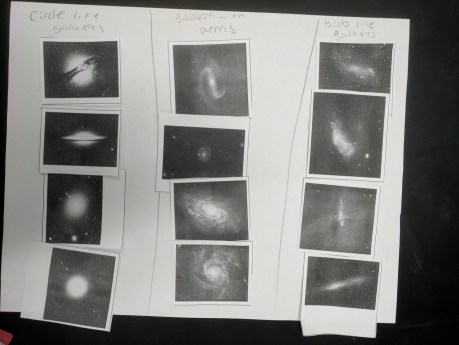
Students were given pictures of a dozen galaxies and tasked with putting them into categories and naming each category. Most groups came up with something pretty close to the three official categories. I can’t decide if I’m happy about that. On the upside, my students are very comfortable with the vocabulary. On the downside, the fact that so many groups got similar results tells me there was limited thinking required.

galaxy-sort

Day 54: Rotational Inertia & Big Bang

AP Physics: Rotational Inertia

We finally collected data and prepped whiteboards for the rotational inertia lab we’ve been working on. Tomorrow, we’ll spend part of the hour on a short whiteboard meeting to figure out what rotational inertia is proportional to. Students did a nice job of working through all the calculations they had to do to get from something they could measure to the rotational inertia, and it was a good review for the final exam later this week.


Earth Science: Big Bang

We discussed the lab from last Wednesday, where students made a graph to find Hubble’s Law. In the discussion, we focused on this result as evidence for the expansion of the universe. Afterwards, I ended up lecturing on the Big Bang Theory and some of the other evidence supporting it. I’m rushing a little bit as I try to cram material in at the end of the tri. Today was a reminder that over the summer, I want to spend some time with the curriculum, comparing it to the required state standards and the district-approved learning targets to get a better idea of what I can cut and where I can add build in more time for scientific practices.