Day 129: Problems, Standing Waves, & Problems

AP Physics 1: Torque Problems

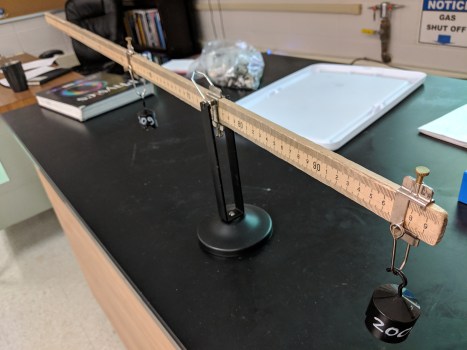
I was much more teacher-directed today than I typically shoot for. I ended up walking students through how to approach balanced torque problems; students were pretty into the idea that they can pick a pivot point for the problem that lets them solve for different quantities. We had a few minutes at the end for some whiteboarding. While students aren’t confident yet, I think they are doing just fine on balanced torques.

Physics: Standing Waves

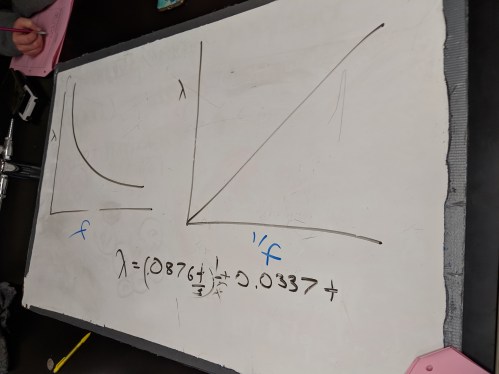
We went through a guided discussion to get at the patterns for standing waves using first a wave generator with a string, then a singing rod, and ending with a tuning fork. When there were some good points for small group discussion, I had students work in their packets, but I think it would have been better to have them use whiteboards.

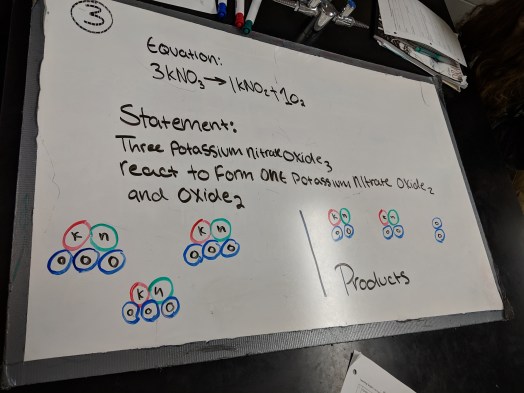
Chemistry Essentials: Stoichiometry Problems

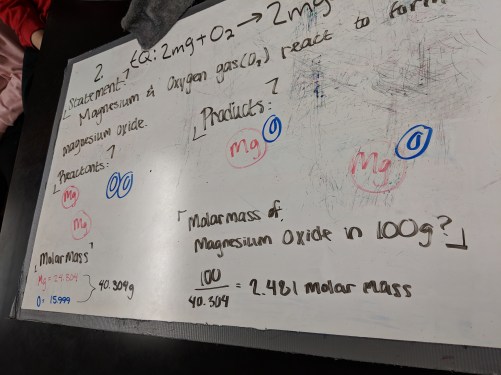
Students worked some stoichiometry problems. We stuck to whole number ratios so students could draw particle diagrams as a tool to work through the problems.

Day 128: Problems, Tuning Forks, & Stoichiometry

I was on a field trip today, so had a sub.

AP Physics 1: Balanced Torque Problems

Students worked some problems with balanced torques. I wish I’d edited the worksheet to include some problems revisiting forces, but ran out of time last week. I’ll be interested to see if and how my students used the area model I showed them yesterday.

Physics: Tuning Forks

Students did a lab playing with tuning forks to start building some ideas about sound waves. There’s usually some good discussion that I’m a little sorry I missed.

Chemistry Essentials: Stoichiometry

Students started doing stoichiometry by using nuts, bolts, and washers to represent different types of atoms, making it possible for them to “see” how many moles they have and measure the masses very directly.

Day 127: Board Meeting, Slinkys, & Molar Mass

AP Physics 1: Torque Board Meeting

We had our board meeting to get to the definition of torque. As expected, in the class where I had students plot the ratio of the forces on one axis and the ratio of the radii on the other, results were rough and I had to step in. In my other section, results came out beautifully and students were quick to figure out why their graphs had intercepts. I also introduced students to Brian Frank’s area models for torque, which students seemed to grasp.

ap lever board.jpg

Physics: Slinkys

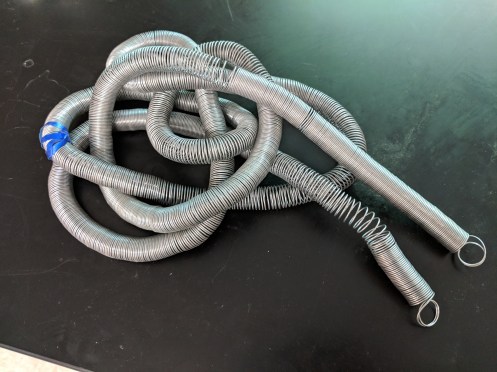
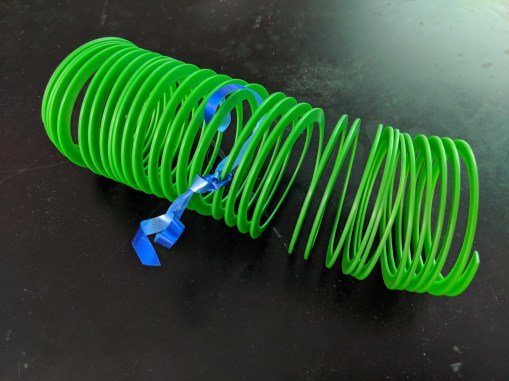
We used slinkys to start figuring out some ideas about longitudinal waves. Students were pretty successful at noticing the things I wanted them to notice. As with transverse waves, we tied some ribbons on the spring to help track the particle motion.

slinky.jpg

Chemistry Essentials: Molar Mass Lab

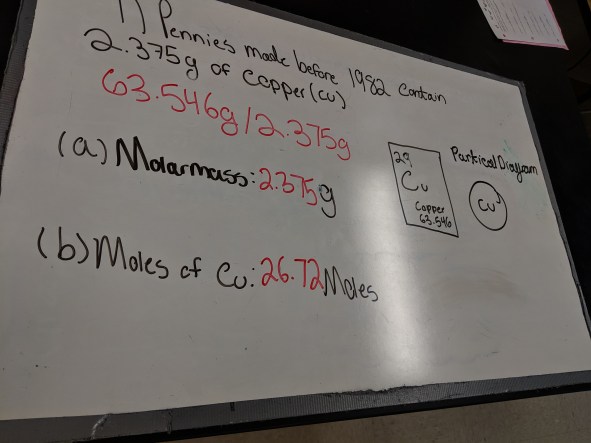
I got out samples of several different materials, and had students weigh a sample and figure out how many moles they had. Not the most dramatic lab, but it was some good practice.

Day 126: Levers & Whiteboarding

AP Physics 1: Levers

Students did a lab with levers to introduce torque. I usually take 3-4 days on lever labs, so tried to shorten it. In my 2nd hour, I had students graph the ratio of the forces on one axis and the ratio of the radii on the other; the results so far are looking messy, so I think I tried to accomplish too much with that approach. In my other section, I had half the class keep the positions constant and graph the two forces, while the other half of the class keep the forces constant and graphed the distances from the pivot. The results are looking really nice, so I think that was a better abbreviation.

ap lever.jpg

Physics: Whiteboarding

We whiteboarded and discussed a couple of wave problems from TIPERs. Students seemed to find the problems pretty straightforward.

Chemistry Essentials: Gallery Walk

We did a gallery walk to go over Friday’s problems that combined balancing with molar mass. Students are starting to be able to shift away from the blocks we’ve been using for balancing and rely more on their particle diagrams, which is great to see.

chem gallery.jpg

Day 125: Assessment & Problems

AP Physics 1: Assessment

Students took their central net force quiz. Most seemed to feel pretty good about it, even though we moved through the content quickly.

Physics: Wave Problems

Students worked on problems using what we’ve learned this week. The problems went very smoothly.

Chemistry Essentials: Molar Mass Problems

Students worked on some problems combining molar mass with balancing chemical reactions.

Day 124: Gallery Walk, Board Meeting, & Mistakes Whiteboarding

AP Physics 1: Gallery Walk

Students did a gallery walk of some problems dealing with central net force and universal gravitation. There was a lot of good discussion as students worked on their problem, but I’m not sure how much students looked at the other problems.

Physics: Board Meeting

We had a board meeting for the snakey spring lab looking for a relationship between wavelength and frequency.

phys wb

This group used floor tiles as their distance measurement

Chemistry Essentials: Mistakes Whiteboarding

Students worked some problems translating between molar mass and moles of a substance, then did some mistakes whiteboarding to go over the problems.

chem molar mistake.jpg

Day 123: Board Meeting, Snakey Springs, & Molar Mass

Yesterday we had ACT testing for juniors. Seniors had an off-campus learning day.

AP Physics 1: Central Net Force Board Meeting

For yesterday’s off-campus learning day, my students finished collecting data in Pivot Interactives on central net forces. I really enjoyed the discussion of the force vs. mass graphs, when the class realized the units on the slope were the units on acceleration, so we had F=ma.

ap centeal force.jpg

Physics: Snakey Springs

Students used the snakey springs to collect data on a relationship between frequency and wavelength for standing waves.

Chemistry Essentials: Molar Mass

Students used nuts, bolts, and washers to represent different elements in order to discover how to find the molar mass of a compound. Afterward, they tried extending what they’d found to actual compounds. Not only were they very successful at extending their results, their work represented different ways of thinking about polyatomic ions, which was cool.

Day 122: Central Net Force, Snakey Springs, & Gallery Walk

AP Physics 1: Central Net Force

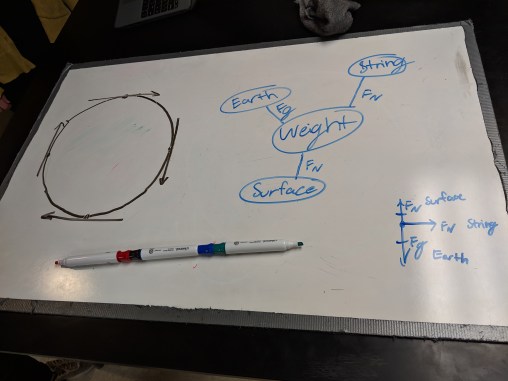
Tomorrow is an off-campus learning day for seniors and freshmen, so I assigned my students to collect and graph data from a Pivot Interactives to determine what affects the force required to keep an object moving in a circle. To prime them, we spent some time today whiteboarding to get at the idea that an object moving in a circle must be experiencing unbalanced forces. Both sections came to a consensus on the free-body diagram pretty quickly and had exactly the conversations I wanted them to on the way.

ap wb.jpg

Physics: Snakey Springs

Students played with snakey springs to start building some ideas about waves. We had them tie a ribbon onto the spring to make it easier to track the particle motion of a small piece of the wave.

phys snakey.jpg

Chemistry Essentials: Gallery Walk

We did a gallery walk of Friday’s problems before moving on to the balancing quiz. A lot of students opted to use the Mathlink cubes during the quiz, which I decided I’m okay with.

chem wb.jpg

Day 121: Quiz & Balancing

AP Physics 1: Circuits Quiz

Students took their quiz over circuits. Afterward, we spent some time using Plickers to practice multiple choice questions. We had some good discussion about how to identify what’s most important in the text of a problem.

Physics: Oscillating Spring Quiz

Students took their quiz on oscillating springs. I haven’t started grading them yet, but students were feeling pretty good.

Chemistry Essentials: Balancing Reactions

Students worked on some balancing problems that involve polyatomic ions in parentheses. The idea of distributing a subscript is tricky for a lot of students, but they made good progress.

Day 120: Mistakes Whiteboarding & Lab Practical

AP Physics 1: Circuits Mistakes Whiteboarding

I forgot to take a picture, but students did some mistakes whiteboarding with yesterday’s problems. We moved quickly enough through circuits that I think I’ll need to make sure I have some circuit materials worked into our review, but students are feeling pretty good about this topic.

Physics: Spring Lab Practical

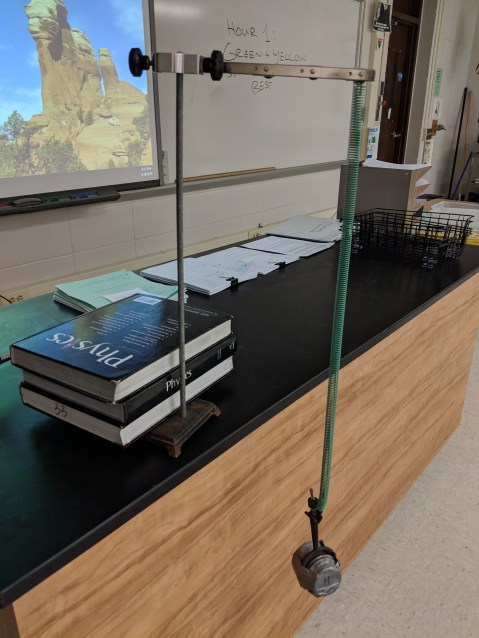
Students finished up a lab practical finding an unknown mass using both Hooke’s Law and the period on a spring. Students who didn’t include units in their work tended to get two different answers; most groups got a spring constant in N/cm and without units in the calculations, they tended to miss the need to convert. It was a good lesson in the value of units. It also occurred to me I should incorporate this lab into my AP review since students are finding both gravitational mass and inertial mass.

spring practical

Chemistry Essentials: Balancing Mistakes

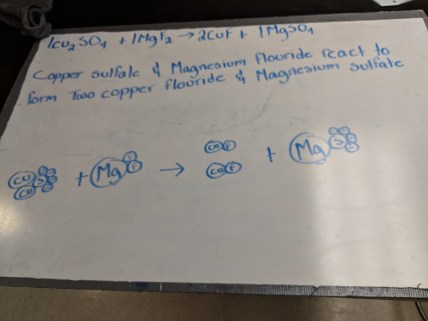
We did mistakes whiteboarding with yesterday’s balancing problems. Right now, students mostly seem to be understanding what to do, but need to build up some confidence. I’m really pleased with how well the Mathlink cubes have been working as a manipulative; they are even helping students quite a bit with going between formulas and particle diagrams.

chem mistake.jpg