Day 64: Energy Practical & Mistakes Game

Physics: Energy Practical

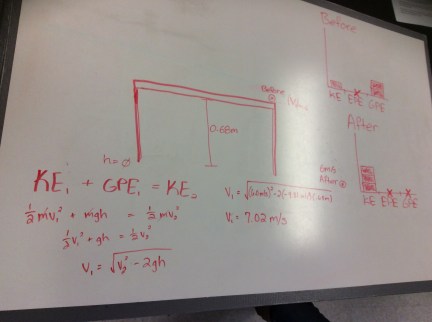
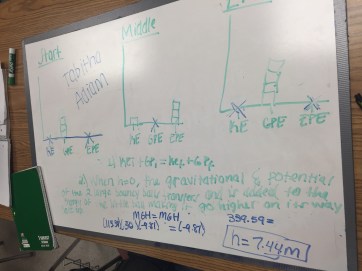
Students were given an elastic string to hang from the ceiling. Students had to find k for their string, then figure out how high above the ground to hold an action figure attached to the end so that, when they dropped it, the figure would just barely hit the ground. In the past, I’ve used a bucket of water and we go by the sound (“splash, but no thud”). This year, the other physics teacher suggested using a force plate and looking for a small spike in the force vs. time graph. While students like the splashing, the force plate is a lot easier to move around, and makes it possible to capture slow-motion video.

Chemistry: Mistakes Game

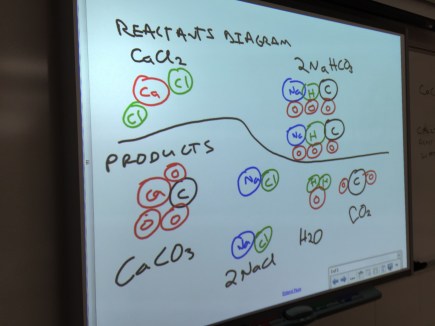
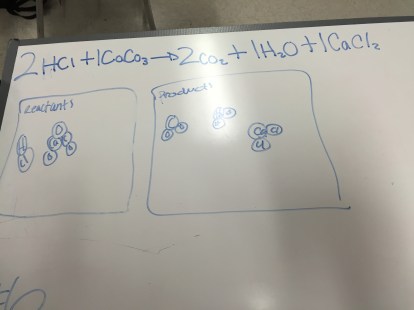
To go over Friday’s practice problems for balancing chemical equations, I had them do the mistakes game. Students focused on making their error an inconsistency in their representations of the reaction. I appreciated how willing my students were to try something new; they seemed to especially appreciate the safety inherent in the mistakes game.
IMG_1513

Day 63: Astroblaster & Balancing Equations

Physics: Astroblaster

After a quiz, students made some observations of the Astro Blaster and used conservation of energy to explain what they saw. Students also worked through some conservation of energy questions out of TIPERs.

IMG_1512

Chemistry: Balancing Chemical Equations

Students used what they found in the simulation yesterday to practice balancing chemical equations. I took a page from the Modeling Chemistry curriculum and had students sketch the molecules in the reaction, which turned out to be a really effective tool to make balancing a much more concrete process.

Day 62: Mistakes Game & Balancing Reactions

Physics: Mistakes Game

We played the mistakes game with yesterday’s conservation of energy problems. For students who had the other physics teacher last trimester, this was their first experience with the mistakes game. I was pleased with the way the students I had last tri took the lead, helping their peers come up with interesting mistakes and modeling good questions.

IMG_0317

The mistake is a subtle sign error, but lead to some great discussion about determining whether an answer is reasonable.

Chemistry: Intro to Balancing Chemical Equations

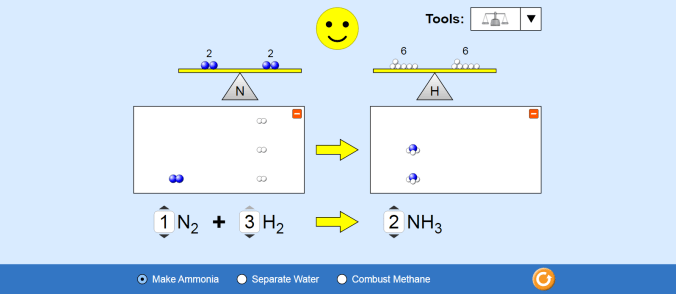
I took advantage of the visuals in PhET’s Balancing Chemical Equations sim to introduce my students to this process. I had them start by playing in the introduction to figure out what the different representations tell them about the chemical equation. After students had some time to play, we came back together. My students were able to articulate pretty clearly what it means for a reaction to be balanced, and what it has to do with conservation of mass. Students then spent some time testing their understanding by playing the game built into the simulation. Based on the conversations I overheard as they played, students were getting a much better understanding of not just how to balance chemical equations, but what all those numbers in the equation mean. I was also pleased to see the confidence my students gained while playing the game. I think a lot of them have started to assume they don’t understand things in the classroom, so seeing that immediate, consistently positive feedback from the game helped them see the way they’re thinking about these reactions really is useful.

phet balancing

Day 61: Problems & Representing Reactions

Physics: Conservation of Energy Problems

Students took their first look at conservation of energy calculations. I use a lot of problems that we could have done with earlier models to try to drive home that energy is a different way of looking at some very similar situations.

Chemistry: Representing Chemical Reactions

My students continued to practice translating between representations of chemical reactions. Several students were very confident by the end of the hour. I think we’re ready to look at balancing equations tomorrow.

Day 60: Bar Charts & Representing Reactions

Physics: Bar Charts

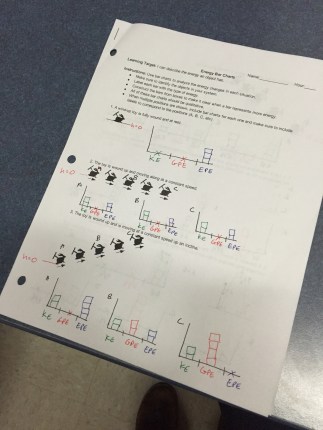
We used yesterday’s lab to define kinetic and gravitational potential energy, then students took their fist stab at drawing energy bar charts. Students took to the bar charts pretty easily.

IMG_1510

Chemistry: Representing Reactions

Today, students practiced translating between representations of a chemical reaction. Given a balanced equation for a reaction, I had them write a statement. This year, I took a page from the Modeling Instruction chemistry curriculum and also had them sketch a diagram that showed the atoms for both the reactants and products.

IMG_1509

Day 59: Energy Introduction & Conservation of Mass

Physics: Energy Introduction

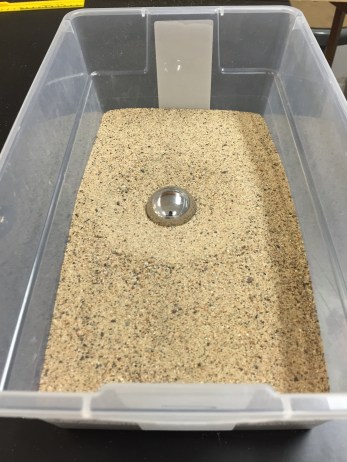
To introduce energy, we used a lab my colleague has done in the past. Students dropped a steel ball into a bucket of sand and measure the depth of the crater. I haven’t told my students yet, but we’re using the crater depth as a proxy for energy, similar to the “chalk-smashing ability” in Etkina’s PUM curriculum. Students collected data and graphed to get a relationship between the crater depth and the drop height, which we’ll use tomorrow to help define gravitational potential energy. I also had students use free fall to calculate the impact speed of the ball and graph the relationship between crater depth and impact speed, which will lead to the definition of kinetic energy.

IMG_1506

Chemistry: Conservation of Mass

This trimester, instead of teaching 9th grade physical science, I’m teaching the second half of a course called Chemistry Essentials. This two trimester course meets the minimum graduation requirements for my district. Most of the students tend to struggle in school, for a wide variety of reasons, and there is a high percentage of students who qualify for special education services.

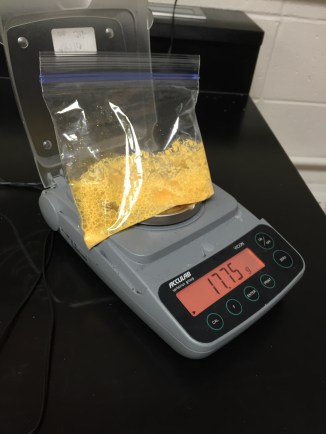
The first unit deals with writing and balancing chemical equations, so I decided to start with conservation of mass. Students put calcium chloride, sodium bicarbonate, and bromothymol blue into a sealed plastic bag, tracking the mass of everything involved. Once the reaction was finished, they measured the mass of the bag and its contents and found the total mass had stayed the same. I also had them measure the mass after removing as much gas as possible. The main issue was students had some trouble getting the plastic bag all the way on the pan of the balance, which impacted the mass they measured at the end. Next time, I’ll try having students set their bag in a rigid container like a beaker to get the total mass.

IMG_1508