Day 105: Magnetic Force Problems & Gallery Walk

Physics: Magnetic Force Problems

Students worked on some problems calculating the magnetic force on a current-carrying wire and a moving charge. Tomorrow, we’ll whiteboard the problems.

One of my students was eager to tell me about his visit to University of Minnesota-Duluth on Friday. He got a chance to hear from a physics professor about the use of inquiry, collaboration, and discovery learning in the physics courses, including why UMD takes that approach. The student was very excited to tell me UMD’s intro physics sounds just like my class, but with calculus, and that I must know what I’m doing if I’m teaching the same way as a professor. February and end of tri are always draining, so it was nice to get this boost from a student.

Chemistry: Gallery Walk

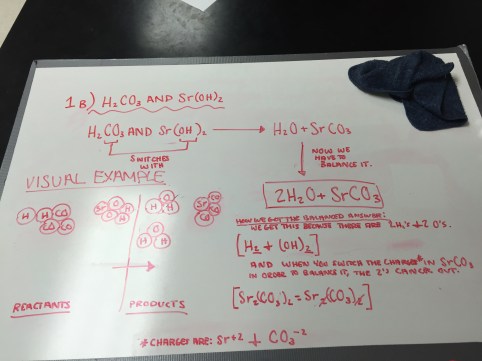
A lot of students in this class are very uncomfortable presenting whiteboards, so I decided to do a gallery walk. Each pair prepared a whiteboard of their solution to one of the problems and I checked their work. Then, one partner took their sheet and visited other whiteboards while the other partner stayed put to answer any questions on their solution. One student went above and beyond writing out the work for their solution, so her board was a very popular stop!
IMG_1680

Day 104: Electromagnets & Neutralization

Physics: Electromagnets

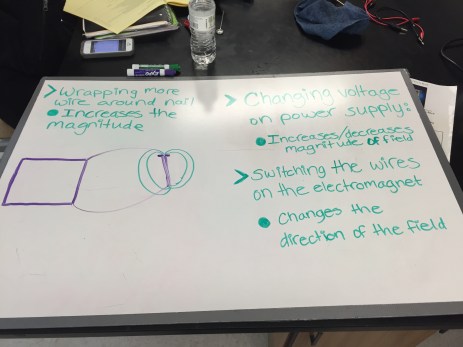
We finished Friday’s lab exploring electromagnets and students compared results. I had students look for as many ways as they could to change the properties of the field around the electromagnet. I was surprised to have several groups decide to try flipping the nail in their electromagnet to test what effect that had. I was glad they did, because it reinforced that the nail itself was not the source of the magnetism.

IMG_1677

Chemistry: Neutralizaiton

I did some grade checks during class on Friday, so the students weren’t asking very many questions on the neutralization worksheet and, as a result, almost no one had gotten past the example I did on Friday. We spent some time revisiting how to write the equation for a neutralization reaction and students got some time to work.

Day 103: Electromagnets & Neutralization

Physics: Electromagnets

Students built electromagnets, then started exploring to try and describe the shape and direction of the magnetic field and to find ways to affect the magnetic field. A lot of groups were quick to come up with tests to see if the electromagnets behave like bar magnets.


Chemistry: Neutralization

Students practiced writing equations for neutralization reactions and predicting the products. The biggest challenge was how many different ideas, including formula writing and balancing equations, they had to combine. My students got very good at both of those skills, but we didn’t use them much the last two weeks, and some students struggled to rediscover their previous fluency. I need to do a better job of spiraling some of these key concepts so that students don’t have the opportunity to get rusty.

Day 102: Kirchoff’s Rules Revisited & PPM

Physics: Kirchoff’s Rules Revisited

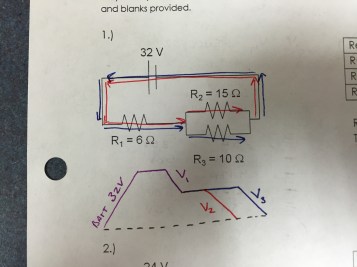
Since the last quiz over Kirchoff’s Rules didn’t go as well as I’d hoped, we took some time to revisit the concepts and try a few more problems. Students left a lot more comfortable. They also really responded to an analogy I got from Kelly O’Shea thinking of current as people flowing through a hallway. It was pretty easy to get them to see that adding a new route in the halls made it easier to get around, which helped them get that adding a parallel branch actually reduces the resistance.IMG_1674

Chemistry: Parts Per Million

Today, students did some calculations using parts per million as a measure of concentration. They were pretty surprised at how small a number you get when you convert ppm into a percent concentration by mass, along with the fact that those low concentrations are really pretty significant in their impacts.

Day 101: Right Hand Rule & Solubility

Physics: Right Hand Rule

I introduced students to the right hand rule, then had them work through some problems applying it. Next year, I need to get some concrete, first-hand examples; I’d love to find a beefy enough horseshoe magnet to deflect a length of wire. Students did make some nice connections to projectile motion when looking at the path of a charged particle.

IMG_1673

Chemistry: Solubility

We had some post-lab discussion on yesterday’s solubility lab. I tried to focus the conversation on evidence, since my students often get caught up in focusing on the answer alone. We also talked about some graph interpretation, such as what their sugar dissolved vs. temperature graphs should look like if there were no relationship and why many of their graphs look linear, while the “real” graph is a curve.

Day 100: Magnetic Field from a Wire & Solubility of Sugar

Physics: Magnetic Field from a Wire

Students made some observations of the deflection of a compass around a current-carrying wire. Results were okay; I think I need to find some resistors that can handle bigger currents to make the effects more visible.

IMG_1672

Chemistry: Solubility of Sugar

Students measured how much sugar they could dissolve in water at different temperatures to produce a solubility curve.

Day 99: Magnets & Concentration 

Physics: Magnets

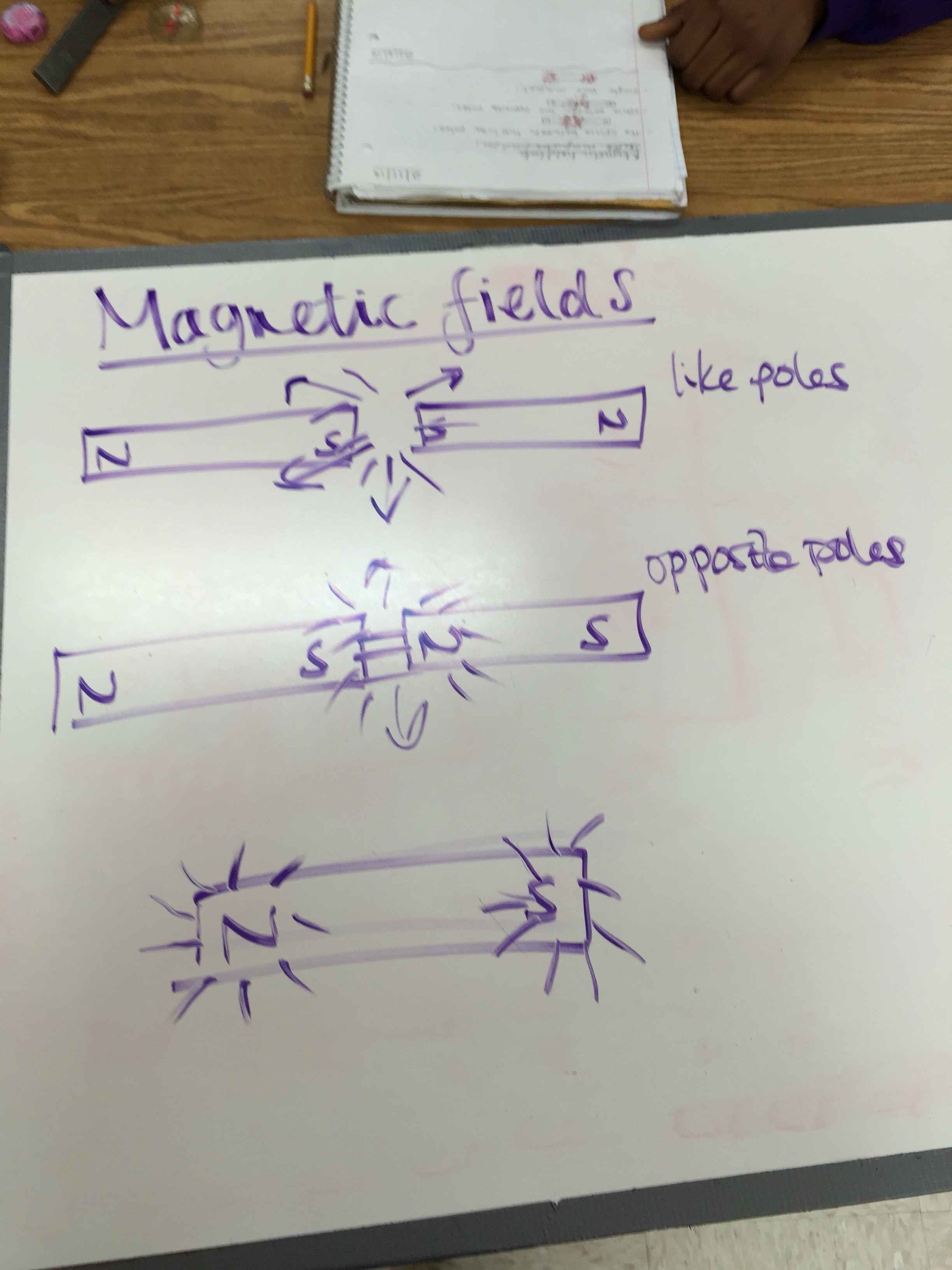
Students used yesterday’s observations to start sketching magnetic field lines. I also had them try to magnetize different materials; a lot were surprised to find that copper wire didn’t respond to their magnets. I ended by dropping a strong magnet through a copper pipe to give them something to puzzle over during the long weekend.

Chemiatry: Concentration

Students worked some concentration problems. I tried to take the opportunity to focus on more familiar contexts for problems, basing problems on what you could get at a drug store or grocery store, and the concrete settings seemed to help a lot of students.

Day 98: Magnets & Solutions

Physics: Magnets

Students used compasses, iron filings, and bar magnets to start exploring magnetic fields. Students are getting more skilled at finding ways to dig into a new phenomena and a lot of groups made observations that started to show how the magnetic force depends on distance.

IMG_1651

Chemistry: Solutions

We broke out the textbooks to introduce some vocabulary related to solutions. Students were able to find some connections between concentration and percent composition, which was great given that many of my students started the trimester seeing what happens in school, and especially science classes, as a series of confusing, unrelated events.

Day 96: Compound Circuits & Empirical Formulas

Physics: Compound Circuits

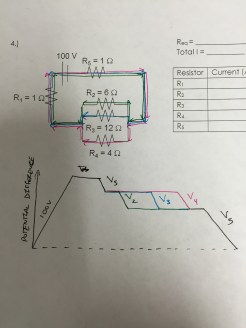
Students continued to work on yesterday’s compound circuit problems. A few students yesterday traced different paths through the circuits using colored arrows to provide a visual cue for which currents should add up, and a lot of students today found it helpful to add that representation. I was really pleased when a student insisted that the last problem, with the most complicated circuit, was the easiest in the set.

IMG_1648

Chemistry: Empirical Formulas

Students finished up the lab from yesterday, then worked on some written problems finding empirical formulas. I didn’t take the time to discuss the connections between what the lab represented and what they were doing in the problems, and many students struggled to not only transfer ideas from the lab, but to bring back skills like converting mass to moles. I need to make sure I take the time to help students build those connections.

Day 95: Compound Circuits & Empirical Formulas

Physics: Compound Circuits

Students worked on applying Kirchoff’s Voltage Law and Kirchoff’s Current Law to solve compound circuits. A lot of students made use of my colored pencil’s and of Trevor Register’s KVL diagram to help set up their equations. During the labs last week, I had a lot of groups come up with patterns based on ratios (i.e. every resistor in series has the same ratio of potential difference to resistance), but very few students set up ratios in the problems. I found that a lot of groups needed some prompting to think about how the labs last week relate to today’s problems. Next year, I may try doing some compound circuits in the lab or PhET circuit kit as a bridge to pure paper and pencil problems.

IMG_1645

Chemistry: Empirical Formulas

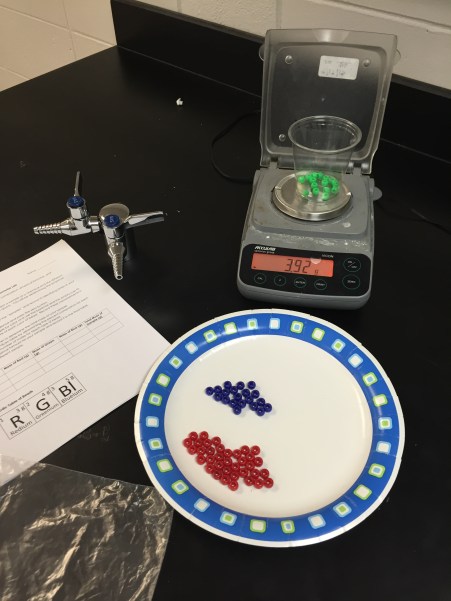
Students found empirical formulas for samples of colored beads, where each color represents a different element. My goal was to give a concrete analogy for what is happening in the lab when they find an empirical formula.

IMG_1644