Day 78: Electric Field Lines & Energy in Reactions

Physics: Electric Fields

Students built off what they can see in the PhET Charges & Fields to develop the idea of what electric field lines represent. Students mostly got into trouble when they  thought their answers were too obvious and tried to come up with something more complicated.
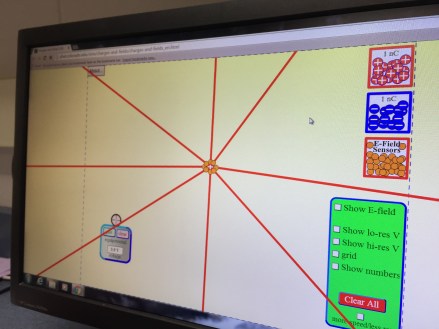
IMG_1587

Chemistry: Endothermic & Exothermic Reactions

To introduce endothermic and exothermic reactions, we broke the terms down and talked about other words with the “therm” root and what that says about what these new terms might mean. Students then did some reading about endothermic and exothermic reactions. While the textbook doesn’t emphasize the role of energy in these reactions, I tried to bring that out in the short discussion after the reading.

Day 77: Board Meeting & Activity Series

Physics: Electric Fields Board Meeting

Students whiteboarded their graphs from yesterday’s electric fields simulation. I was really pleased with how quick students were to bring up Coulomb’s Law as a way to check if their relationships made sense. There was also some good discussion about why linearization is useful, where several groups shared their initial attempt to linearize using a purely inverse (rather than inverse-square) relationship between field strength and distance.

IMG_1583

Chemistry: Activity Series

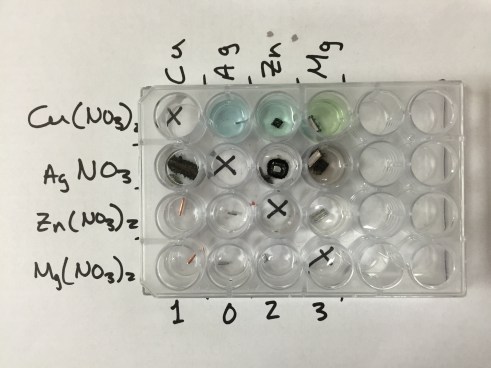
Students dropped four different metals into four different solutions to see how many times each metal reacted. They were able to rank the metals in a crude activity series, then we looked at how that activity series could explain which solutions each metal reacted with.

IMG_1586


Day 76: Electric Fields & Interpreting Reactions

Physics: Electric Fields

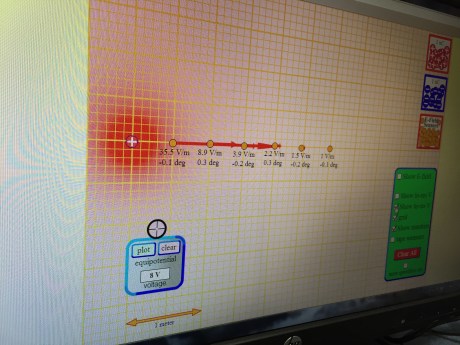
Students used PhET’s Charges and Fields sim to look at how the size of a charge and the distance from a charge impact the magnitude of an electric field. Tomorrow, we’ll get from their data to the equation for electric field strength and draw some parallels between electric fields and gravitational fields.

IMG_1582

Chemistry: Interpreting Reaction Equations

Students worked on using chemical equations to determine which of the five reaction types was happening. I was really pleased by the way students started to talk about what is actually happening in the reaction, rather than just talking about the abstractions represented in the equation.

Day 74: Board Meeting & Observations

Physics: Coulomb’s Law Board Meeting

Students whiteboarded the results of yesterday’s lab and we had a board meeting. I had students graph force vs. distance, then both an inverse and inverse-square test plot so we could compare the correlation coefficients. While both classes were able to get to the inverse-square relationship, I struggled to get students to take the lead in the discussion. I think part of the problem is, while we’ve whiteboarded lots of problems and conceptual questions, the last board meeting where we focused on graphs produced in a lab was early November. I need to either do more whiteboarding labs during projectile motion and energy, or I need to bring in more of the scaffolding I do early in the year to help students refresh their skills.

IMG_1574

Chemistry: Observations of Reaction Types

Students finished up the lab from yesterday, then we spent some time trying to connect their inferences to their observations in the lab. In the discussion, I realized I need to make explicit to my students what is a good observation and how that contrasts with an inference or claim. For example, the textbook lists gas formation as a sign of a chemical reaction, so nearly every student listed gas formation as an observation at least once, but struggled to explain what they saw that suggested a gas was formed. I can’t forgot how important it is to explicitly address the basics in a class like this.

IMG_1572

Day 73: Coulomb’s Law & Reaction Types Lab

Physics: Coulomb’s Law

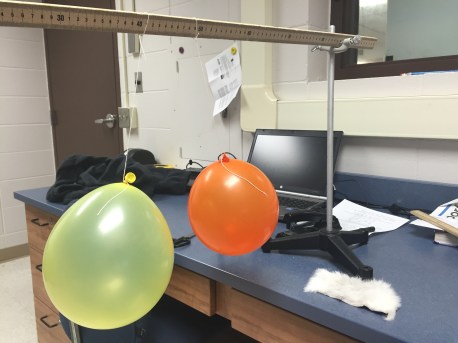
Students used fur to charge a pair of balloons hanging from a meter stick, then measured the angle the strings were at as a proxy for the force. They then collected data to find a relationship between the force the balloons exert on each other and the distance they are separated.

IMG_1568

Chemistry: Reaction Types Lab

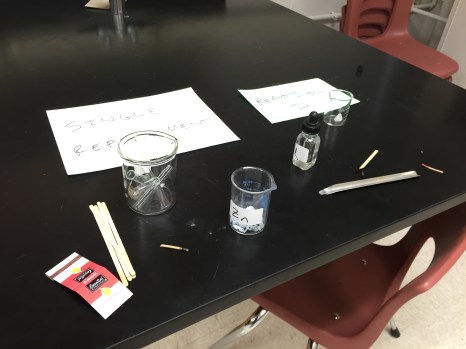
I borrowed a lab from the Modeling Instruction chemistry curriculum where students actually carried out reactions of each type, and  made some observations to connect the reaction equation to what actually happened in the lab.

IMG_1566

Day 71: Electrostatics Intro & Review

Physics: Electrostatics

This year, I decided to try the electrostatics labs from Eugenia Etkina’s PUM curriculum. The effects were pretty visible and just about every student, including the ones concurrently enrolled in AP Chemistry where they just finished Coulomb’s Law, made some observation they found surprising.

IMG_1563

Chemistry: Review

In preparation for tomorrow’s lab, I had students balance the equations for the reactions they’ll be doing, as well as categorize each reaction into the five types that were introduced right before break.

Day 70: Projectile Launchers & Reaction Types

Physics: Projectile Launchers

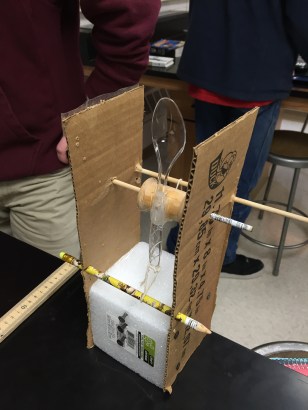
After a quiz, students continued to work on testing and refining their projectile launchers. In spite of the fact that its the last day before break, both of my classes were focused and working right up until the bell!IMG_1552

Chemistry: Reaction Types

After a quiz on molar mass, students did a jigsaw on the types of chemical reactions. Each group used the textbook to make a whiteboard with some key points about their reaction type, then students used the whiteboards to make themselves a quick reference on the reaction types.

Day 64: Energy Practical & Mistakes Game

Physics: Energy Practical

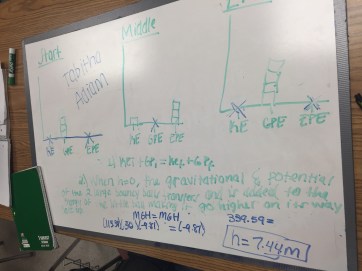
Students were given an elastic string to hang from the ceiling. Students had to find k for their string, then figure out how high above the ground to hold an action figure attached to the end so that, when they dropped it, the figure would just barely hit the ground. In the past, I’ve used a bucket of water and we go by the sound (“splash, but no thud”). This year, the other physics teacher suggested using a force plate and looking for a small spike in the force vs. time graph. While students like the splashing, the force plate is a lot easier to move around, and makes it possible to capture slow-motion video.

Chemistry: Mistakes Game

To go over Friday’s practice problems for balancing chemical equations, I had them do the mistakes game. Students focused on making their error an inconsistency in their representations of the reaction. I appreciated how willing my students were to try something new; they seemed to especially appreciate the safety inherent in the mistakes game.

IMG_1513

Day 63: Astroblaster & Balancing Equations

Physics: Astroblaster

After a quiz, students made some observations of the Astro Blaster and used conservation of energy to explain what they saw. Students also worked through some conservation of energy questions out of TIPERs.

IMG_1512

Chemistry: Balancing Chemical Equations

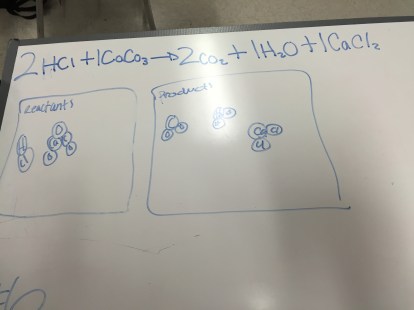
Students used what they found in the simulation yesterday to practice balancing chemical equations. I took a page from the Modeling Chemistry curriculum and had students sketch the molecules in the reaction, which turned out to be a really effective tool to make balancing a much more concrete process.

Day 62: Mistakes Game & Balancing Reactions

Physics: Mistakes Game

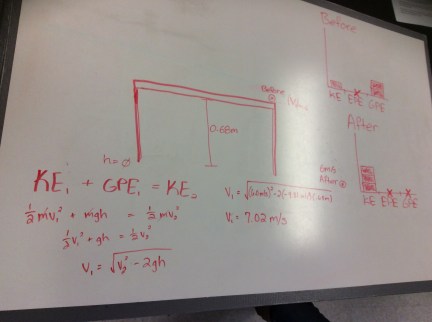
We played the mistakes game with yesterday’s conservation of energy problems. For students who had the other physics teacher last trimester, this was their first experience with the mistakes game. I was pleased with the way the students I had last tri took the lead, helping their peers come up with interesting mistakes and modeling good questions.

IMG_0317

The mistake is a subtle sign error, but lead to some great discussion about determining whether an answer is reasonable.

Chemistry: Intro to Balancing Chemical Equations

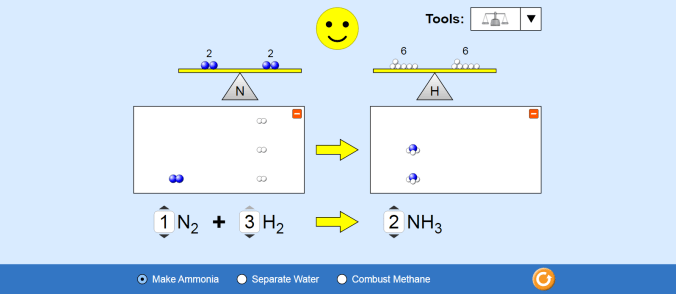
I took advantage of the visuals in PhET’s Balancing Chemical Equations sim to introduce my students to this process. I had them start by playing in the introduction to figure out what the different representations tell them about the chemical equation. After students had some time to play, we came back together. My students were able to articulate pretty clearly what it means for a reaction to be balanced, and what it has to do with conservation of mass. Students then spent some time testing their understanding by playing the game built into the simulation. Based on the conversations I overheard as they played, students were getting a much better understanding of not just how to balance chemical equations, but what all those numbers in the equation mean. I was also pleased to see the confidence my students gained while playing the game. I think a lot of them have started to assume they don’t understand things in the classroom, so seeing that immediate, consistently positive feedback from the game helped them see the way they’re thinking about these reactions really is useful.

phet balancing