Day 79: Electric Field Lines & Energy in Reactions

Physics: Electric Field Lines

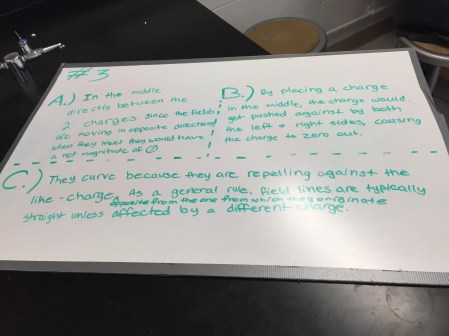
Students whiteboarded their answers to yesterday’s worksheet. The time we spent on vector addition diagrams with forces paid off as students were very successful adapting those to make sense of electric fields.
IMG_1589

Chemistry: Energy in Reactions

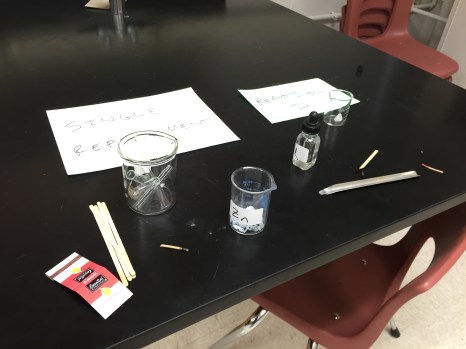
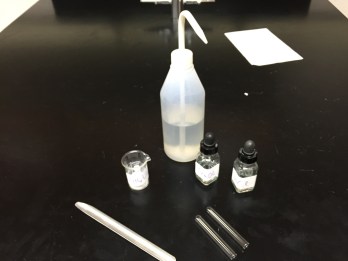
We started with a “mini-lab” to give students some first-hand, tactile experience with endothermic and exothermic reactions. After that, I tried having them sketch bar charts for those reactions, but it was clear I hadn’t done enough to help them understand what energy is, let alone the different types of energy that will appear in a chemical reaction, so the bar charts ended up a confusing abstraction for most students. I need to rethink how I approach reaction types next time to give students a better foundation in energy.
IMG_1588

Day 78: Electric Field Lines & Energy in Reactions

Physics: Electric Fields

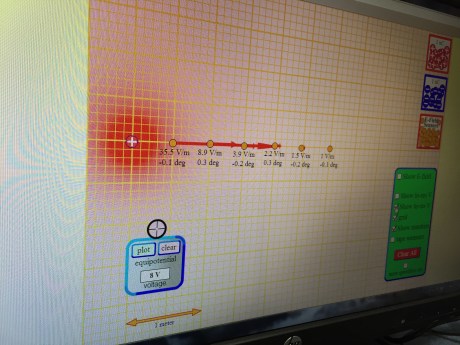
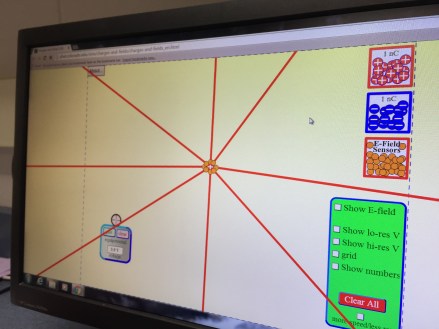
Students built off what they can see in the PhET Charges & Fields to develop the idea of what electric field lines represent. Students mostly got into trouble when they  thought their answers were too obvious and tried to come up with something more complicated.

IMG_1587

Chemistry: Endothermic & Exothermic Reactions

To introduce endothermic and exothermic reactions, we broke the terms down and talked about other words with the “therm” root and what that says about what these new terms might mean. Students then did some reading about endothermic and exothermic reactions. While the textbook doesn’t emphasize the role of energy in these reactions, I tried to bring that out in the short discussion after the reading.

Day 77: Board Meeting & Activity Series

Physics: Electric Fields Board Meeting

Students whiteboarded their graphs from yesterday’s electric fields simulation. I was really pleased with how quick students were to bring up Coulomb’s Law as a way to check if their relationships made sense. There was also some good discussion about why linearization is useful, where several groups shared their initial attempt to linearize using a purely inverse (rather than inverse-square) relationship between field strength and distance.

IMG_1583

Chemistry: Activity Series

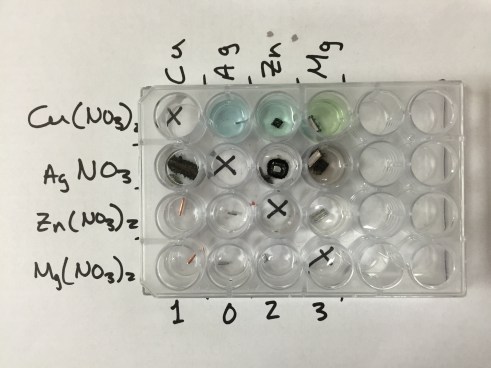
Students dropped four different metals into four different solutions to see how many times each metal reacted. They were able to rank the metals in a crude activity series, then we looked at how that activity series could explain which solutions each metal reacted with.

IMG_1586


Day 76: Electric Fields & Interpreting Reactions

Physics: Electric Fields

Students used PhET’s Charges and Fields sim to look at how the size of a charge and the distance from a charge impact the magnitude of an electric field. Tomorrow, we’ll get from their data to the equation for electric field strength and draw some parallels between electric fields and gravitational fields.

IMG_1582

Chemistry: Interpreting Reaction Equations

Students worked on using chemical equations to determine which of the five reaction types was happening. I was really pleased by the way students started to talk about what is actually happening in the reaction, rather than just talking about the abstractions represented in the equation.

Day 75: Coulomb’s Law & Mystery Tube

Physics: Coulomb’s Law

Students worked a few problems using Coulomb’s Law. I was really pleased to see how smoothly students integrated what they’d learned about Newton’s Laws back in November with the new concept. Something about today lead several students to say they feel like they finally understand how to learn physics, which was great to hear.

Chemistry: Mystery Tubes

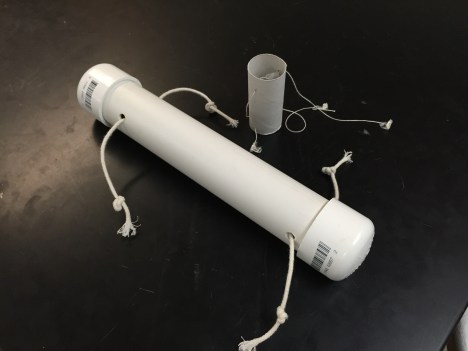
After this week’s lab, I wanted to spend some time on observations, inferences, and the nature of science. We talked a bit about the difference between observations and inferences, and what makes a good example of each, then asked them to make some observations and inferences about a few photographs. A photo of a crying baby lead to some great discussion when I started to list the crying under observations and several students disagreed and proposed some other explanations for the baby’s facial expression. I love it when students are confident enough in their ideas and comfortable enough in the classroom to challenge me. After the photos, I got out a pair of “Mystery Tubes” and asked students to try to come up with some inferences about what’s inside the tube, then use toilet paper tubes and string to test their inferences. There was some great discussion as students proposed ideas, then challenged what their peers were thinking, always talking about the evidence they have. Going forward, the challenge will be to make sure students are bringing those same skills and enthusiasm to more standard chemistry labs.

IMG_1575

Day 74: Board Meeting & Observations

Physics: Coulomb’s Law Board Meeting

Students whiteboarded the results of yesterday’s lab and we had a board meeting. I had students graph force vs. distance, then both an inverse and inverse-square test plot so we could compare the correlation coefficients. While both classes were able to get to the inverse-square relationship, I struggled to get students to take the lead in the discussion. I think part of the problem is, while we’ve whiteboarded lots of problems and conceptual questions, the last board meeting where we focused on graphs produced in a lab was early November. I need to either do more whiteboarding labs during projectile motion and energy, or I need to bring in more of the scaffolding I do early in the year to help students refresh their skills.

IMG_1574

Chemistry: Observations of Reaction Types

Students finished up the lab from yesterday, then we spent some time trying to connect their inferences to their observations in the lab. In the discussion, I realized I need to make explicit to my students what is a good observation and how that contrasts with an inference or claim. For example, the textbook lists gas formation as a sign of a chemical reaction, so nearly every student listed gas formation as an observation at least once, but struggled to explain what they saw that suggested a gas was formed. I can’t forgot how important it is to explicitly address the basics in a class like this.

IMG_1572

Day 73: Coulomb’s Law & Reaction Types Lab

Physics: Coulomb’s Law

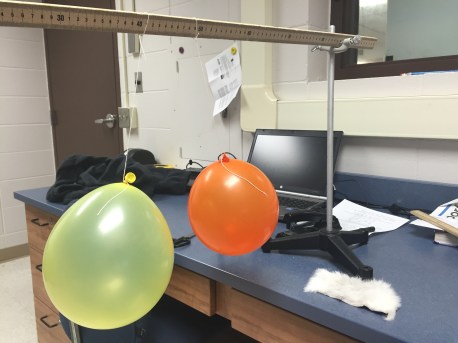
Students used fur to charge a pair of balloons hanging from a meter stick, then measured the angle the strings were at as a proxy for the force. They then collected data to find a relationship between the force the balloons exert on each other and the distance they are separated.

IMG_1568

Chemistry: Reaction Types Lab

I borrowed a lab from the Modeling Instruction chemistry curriculum where students actually carried out reactions of each type, and  made some observations to connect the reaction equation to what actually happened in the lab.

IMG_1566

Day 72: Van de Graaff & Finish Review

Physics: Van de Graaff

We started by discussing the results of yesterday’s lab. It ended up much more teacher-centered than I would have liked; I had a few different concepts I wanted students to take away from the lab, and I wasn’t quite sure how to have students summarize their results on a whiteboard or how to guide the discussion to get students to those concepts. It also didn’t help that about half of my students were on a field trip and the empty room made students more self-conscious about speaking up. After discussing the lab, we played with the Van de Graaff generator. Students did a nice job of using what they’d gotten from the lab to make predictions and construct explanations of what we saw with the generator.

IMG_1564

Chemistry: Finish Review

No one managed to finish yesterday’s assignment, so we spent some time discussing together the parts students had finished, then I gave them time to finish the rest. I’d hoped to start a lab today, but many students needed the whole hour to work.

Day 71: Electrostatics Intro & Review

Physics: Electrostatics

This year, I decided to try the electrostatics labs from Eugenia Etkina’s PUM curriculum. The effects were pretty visible and just about every student, including the ones concurrently enrolled in AP Chemistry where they just finished Coulomb’s Law, made some observation they found surprising.

IMG_1563

Chemistry: Review

In preparation for tomorrow’s lab, I had students balance the equations for the reactions they’ll be doing, as well as categorize each reaction into the five types that were introduced right before break.

Day 70: Projectile Launchers & Reaction Types

Physics: Projectile Launchers

After a quiz, students continued to work on testing and refining their projectile launchers. In spite of the fact that its the last day before break, both of my classes were focused and working right up until the bell!IMG_1552

Chemistry: Reaction Types

After a quiz on molar mass, students did a jigsaw on the types of chemical reactions. Each group used the textbook to make a whiteboard with some key points about their reaction type, then students used the whiteboards to make themselves a quick reference on the reaction types.