Day 99: Magnets & Concentration 

Physics: Magnets

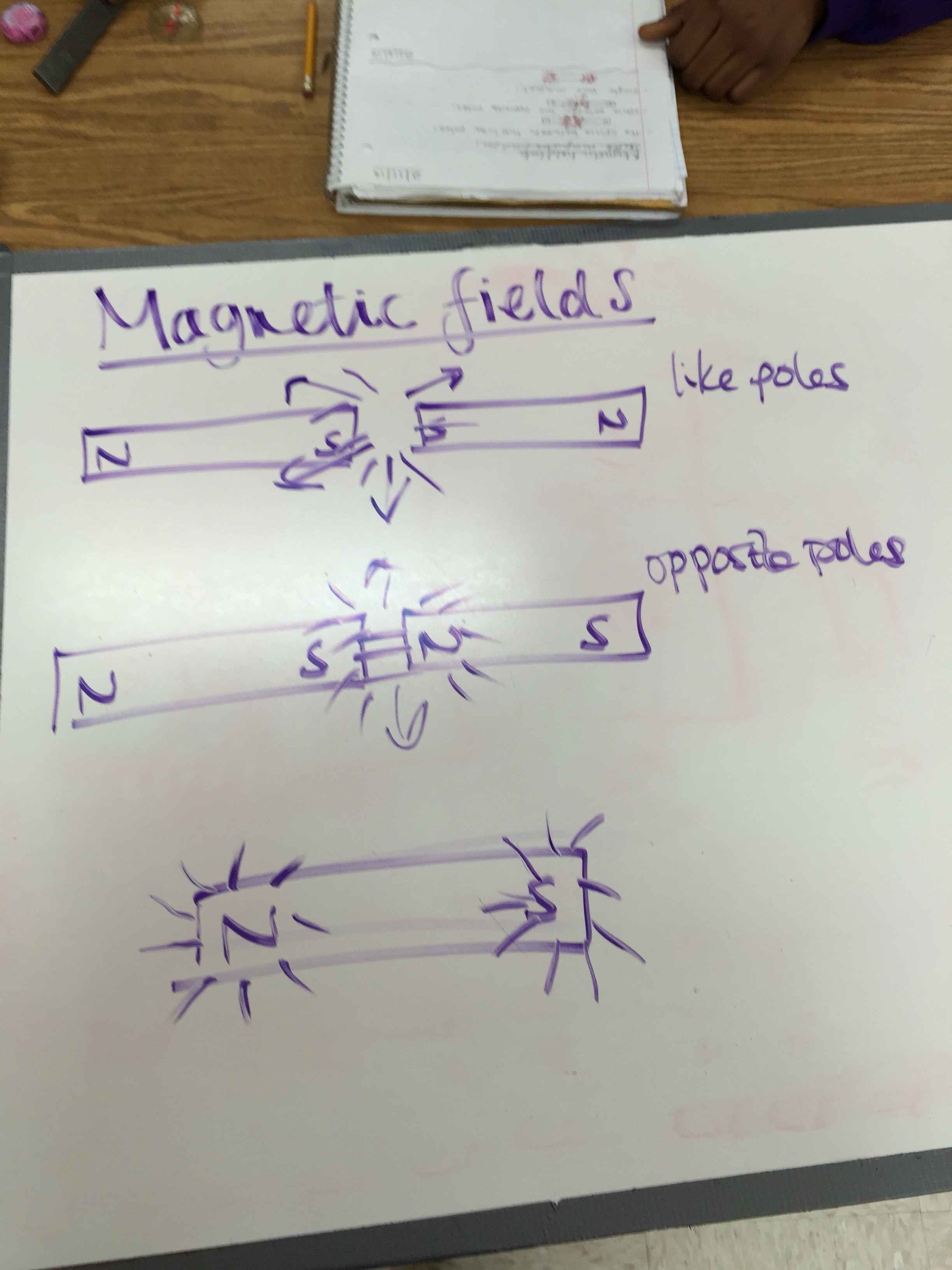
Students used yesterday’s observations to start sketching magnetic field lines. I also had them try to magnetize different materials; a lot were surprised to find that copper wire didn’t respond to their magnets. I ended by dropping a strong magnet through a copper pipe to give them something to puzzle over during the long weekend.

Chemiatry: Concentration

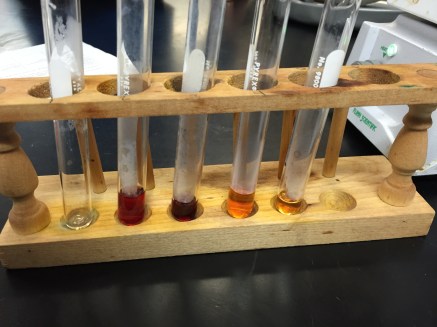
Students worked some concentration problems. I tried to take the opportunity to focus on more familiar contexts for problems, basing problems on what you could get at a drug store or grocery store, and the concrete settings seemed to help a lot of students.

Day 98: Magnets & Solutions

Physics: Magnets

Students used compasses, iron filings, and bar magnets to start exploring magnetic fields. Students are getting more skilled at finding ways to dig into a new phenomena and a lot of groups made observations that started to show how the magnetic force depends on distance.

IMG_1651

Chemistry: Solutions

We broke out the textbooks to introduce some vocabulary related to solutions. Students were able to find some connections between concentration and percent composition, which was great given that many of my students started the trimester seeing what happens in school, and especially science classes, as a series of confusing, unrelated events.

Day 97: Speed Dating

Physics: Circuits Speed Dating

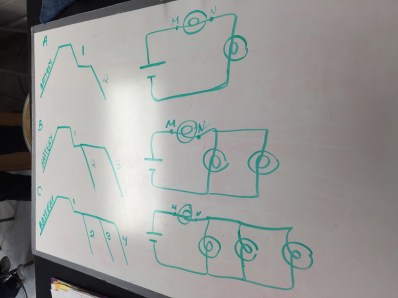
We did some whiteboard speed dating for compound circuit problems. I put different problems at different tables and, compared to when I’ve done all groups working on the same problem, it seemed like students were more willing to try and make sense of what their peers did. One of my favorite side effects is as students get frustrated trying to follow what a classmate did, they get more careful about showing their own work clearly. By the end of the hour, students seemed much more confident with these problems.

IMG_1649

Chemistry: Empirical Formulas Speed Dating

This class also did whiteboard speed dating, but with empirical formulas. In my physics classes, the students who are struggling with a concept try to take advantage of this activity by asking a lot of questions when they’re with someone who has it down and working through at a comfortable pace when they’re with someone else who is struggling, which contributes to the value of the activity. In my chemistry class, I saw something very different. When my students struggling with the topic were with a stronger student, they tended to mostly watch what their partner was writing without much interaction or conversation. When they were with another student struggling with the material, both would seem to shut down and wait for the next rotation. I need to keep working with students on what effective collaboration looks like and how their actions in class day-to-day contribute (or not) to their performance on assessments.
 

Day 96: Compound Circuits & Empirical Formulas

Physics: Compound Circuits

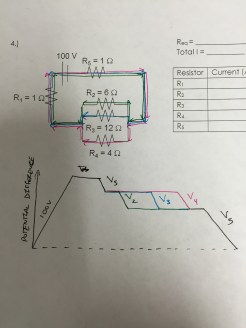
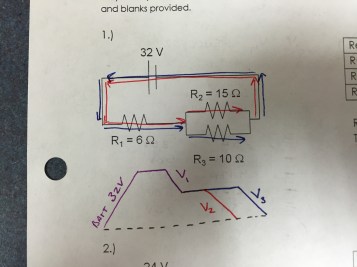
Students continued to work on yesterday’s compound circuit problems. A few students yesterday traced different paths through the circuits using colored arrows to provide a visual cue for which currents should add up, and a lot of students today found it helpful to add that representation. I was really pleased when a student insisted that the last problem, with the most complicated circuit, was the easiest in the set.

IMG_1648

Chemistry: Empirical Formulas

Students finished up the lab from yesterday, then worked on some written problems finding empirical formulas. I didn’t take the time to discuss the connections between what the lab represented and what they were doing in the problems, and many students struggled to not only transfer ideas from the lab, but to bring back skills like converting mass to moles. I need to make sure I take the time to help students build those connections.

Day 95: Compound Circuits & Empirical Formulas

Physics: Compound Circuits

Students worked on applying Kirchoff’s Voltage Law and Kirchoff’s Current Law to solve compound circuits. A lot of students made use of my colored pencil’s and of Trevor Register’s KVL diagram to help set up their equations. During the labs last week, I had a lot of groups come up with patterns based on ratios (i.e. every resistor in series has the same ratio of potential difference to resistance), but very few students set up ratios in the problems. I found that a lot of groups needed some prompting to think about how the labs last week relate to today’s problems. Next year, I may try doing some compound circuits in the lab or PhET circuit kit as a bridge to pure paper and pencil problems.

IMG_1645

Chemistry: Empirical Formulas

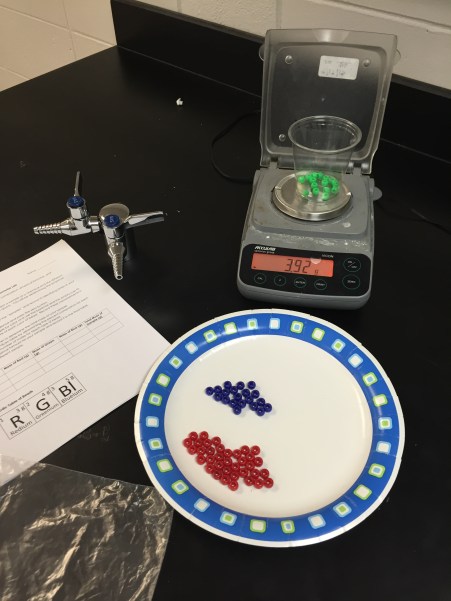
Students found empirical formulas for samples of colored beads, where each color represents a different element. My goal was to give a concrete analogy for what is happening in the lab when they find an empirical formula.

IMG_1644


Day 94: TIPERs & Percent Composition

Physics: TIPERs

I introduced students to Trevor Register’s diagram for Kirchoff’s Voltage Law, then turned them lose on some questions from TIPERs that we used for the mistakes game. A lot of groups made good use of the KVL diagrams both in their groups and during the whole class discussion. We haven’t done the mistakes game much this trimester, but groups did a nice job of using their initial errors as a basis for their mistake.

IMG_1635

Using the KVL diagram

Chemistry: Percent Composition

Students did a lab to find what percentage of a stick of gum is sugar. This is one of the first quantitative labs we’ve done, and students struggled with a question about likely sources of error in their measurements, so that will take some conversation on Monday.

Day 93: Parallel Circuits & Reaction Rates

Physics: Parallel Circuits

Students did the real world version of the parallel circuits lab and put the patterns they’d come up with on whiteboards. After seeing that, in series circuits, the ratio of the resistance to the potential difference across a bulb had some significance, I saw more groups paying attention to the relationship between resistance and the current through a bulb in parallel.

IMG_1633

Chemistry: Reaction Rates

Students finished up the reaction rates lab from yesterday, and we discussed the results. Students are getting more comfortable sharing their ideas and finding their own connections to the material, which mean there were more students contributing to the discussion and I heard a greater range of ideas shared.

Day 92: Parallel Circuit Patterns & Reaction Rates

Physics: Parallel Circuit Patterns

Continuing with Kirchoff’s Laws, students went back to the PhET circuit construction kit to look for patterns in parallel circuits. I have a lot of fun listening to student conversations during this sequence. The patterns that lead to Kirchoff’s Laws are just subtle enough to lead to some great discussion (and emphatic debate), along with lots of moments where students think they’ve got it worked out, only to break their own pattern.

circuit sim

Chemistry: Reaction Rates

Students timed a reaction between copper chloride and hydrogen peroxide, then made various changes to speed up or slow down the reaction. Students were doing a nice job of connecting yesterday’s discussion about energy in chemical reactions  (aided by PhET’s reversible reactions sim) to explain why some of today’s changes impacted the reaction rate.

Day 91: Real Life Circuits & Energy in Equilibrium

Physics: Real Life Circuits

Continuing the circuit patterns set of labs from the PUM curriculum, students used power supplies and resistors to build series circuits and test the patterns they found in the simulation yesterday. Class ended with each group summarizing their rules on a whiteboard. Several groups used proportions to come up with a rule for how much potential difference goes to each resistor; for next year, I want to think about the questions I’m asking to try and get more groups to take a similar leap.


Chemistry: Energy in Equilibrium

Students did a short reading from the book to look at the role energy plays in chemical equilibrium and to help explain some of the results in yesterday’s lab. It also ended up being a nice set-up for the reaction rates lab we’ll be doing tomorrow.

Day 90: Circuit Patterns & Disturbing Equilibrium

Physics: Circuit Patterns

Today, students started working on a series of labs based on the circuit patterns activities from the PUM curriculum. Today, students built series circuits in PhET’s circuit construction kit, measured the current and potential difference at each element, and started looking for patterns in their results. When using the voltmeter, I was pleased by how many students went back to a lab we’d done moving the ground wire of the multimeter to help explain why some voltages were negative, along with what that negative voltage means. Tomorrow, we’ll pull out the power supplies and resistors to see if their patterns work in the real world.

Screen Shot 2016-02-01 at 3.12.16 PM

Chemistry: Disturbing Equilibrium

Students played with moving a reversible reaction out of equilibrium. After mixing Fe(NO3)3 and KSCN solutions in several different test tubes. Once the reaction was in equilibrium, they tried something different, such as changing the concentration or putting the test tube into a water bath, to and observed the results.

IMG_1620